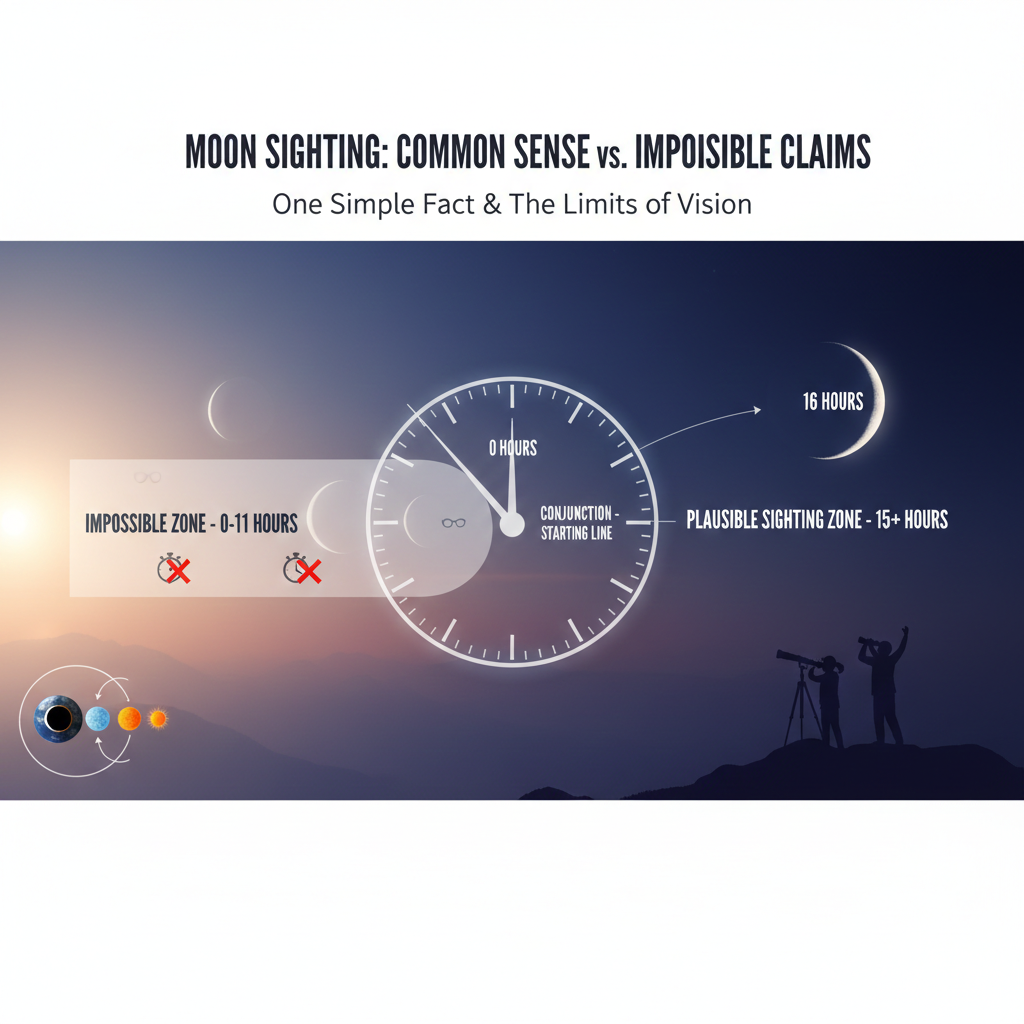
Do you need a PhD in astronomy to evaluate moon sightings. Nope. All you need is one simple fact and a bit of common sense.
We Only Need One Simple Fact
Let’s clear something up right away: Evaluating impossible moon sightings doesn’t require being an astronomer or understanding complex science. We only need ONE piece of information from the field astronomy:
When exactly did conjunction (astronomical new moon) occur?
That’s it. One data point. And here’s the beautiful part – we can verify this information ourselves through eclipse predictions. Every time we see a solar eclipse happen exactly when predicted (to the minute), we’re confirming that astronomers can calculate conjunction time with precision.
This isn’t complex “astronomy” – it’s more like knowing what time the sun rises. It’s a simple, observable fact about our world that anyone can understand. That’s all we need.
Moon Basics: What You Need to Know
Here’s what you need to understand:
- The moon orbits around Earth in about 29.5 days.
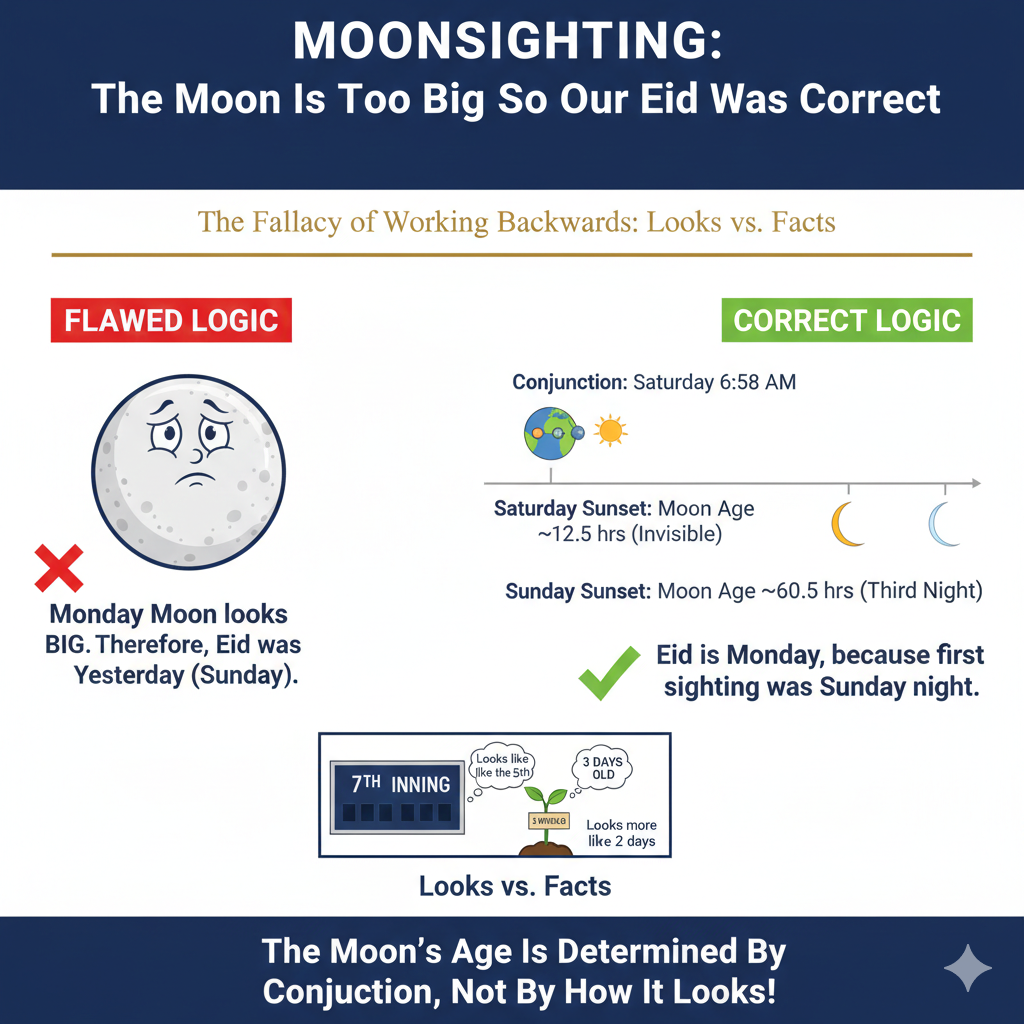
Conjunction is when the moon passes between Earth and sun. At this exact moment, the moon is completely dark from our perspective because the illuminated side faces away from Earth completely.
After conjunction, the moon moves in its orbit, and gradually a tiny sliver becomes illuminated. This is the crescent we look for.
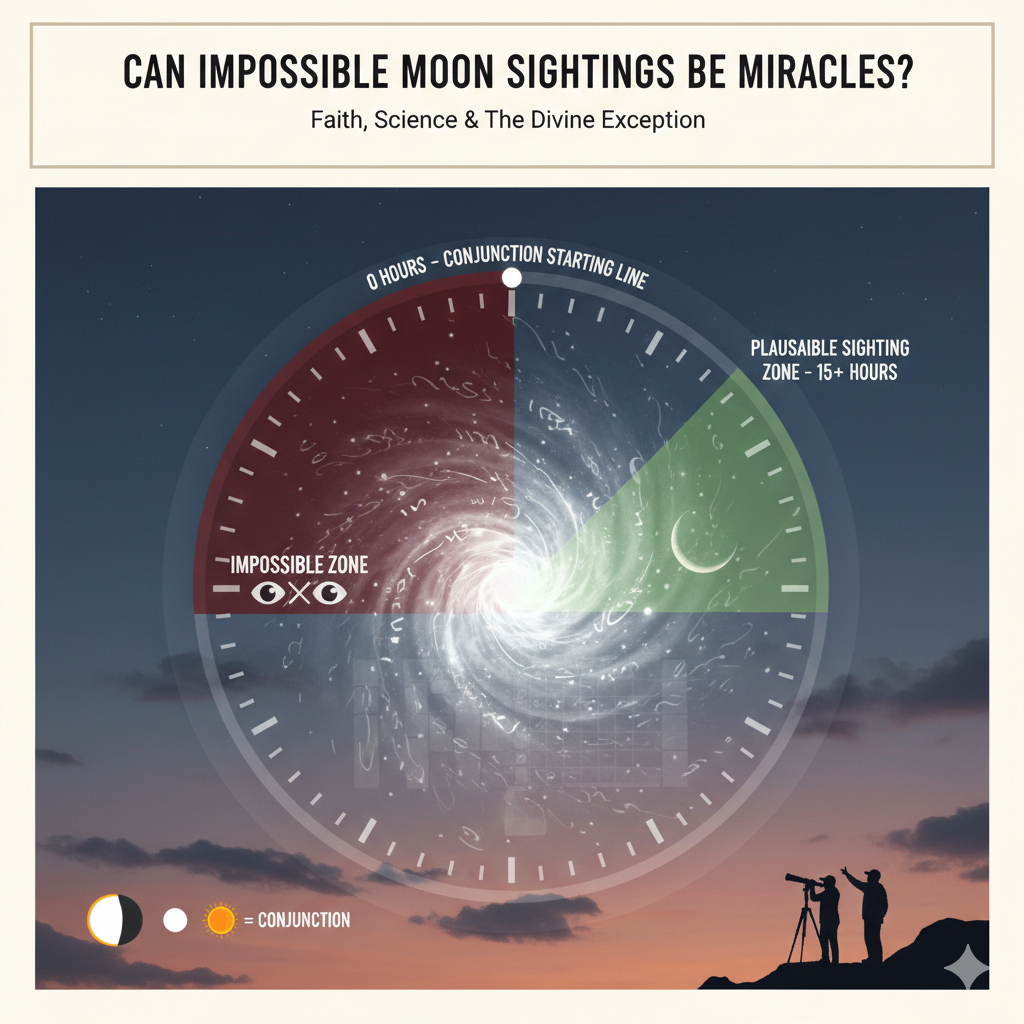
For several hours after conjunction, this crescent is physically impossible to see with human eyes – it’s too thin and has too little contrast against the bright sky.
That’s it! Understanding these basic facts is all you need to evaluate whether a moon sighting claim is possible.
Key Distinctions to Understand
Let’s clarify two important concepts:
* Age of the moon: Determined by conjunction (astronomical new moon)
* Age of the month: Determined by the first visible crescent
Verify It Yourself: No Experts Required
This isn’t about your expert or my expert or specialized knowledge that’s out of your reach. You can verify this information yourself:
- Visit any reputable astronomical website (like the US Naval Observatory, NASA, or even timeanddate.com)
- Look up conjunction (astronomical new moon) times for any month
- Compare these times across different sources
You’ll find they all give the same conjunction time, just as they all give the same sunrise or sunset time. There’s no disagreement about when conjunction occurs.
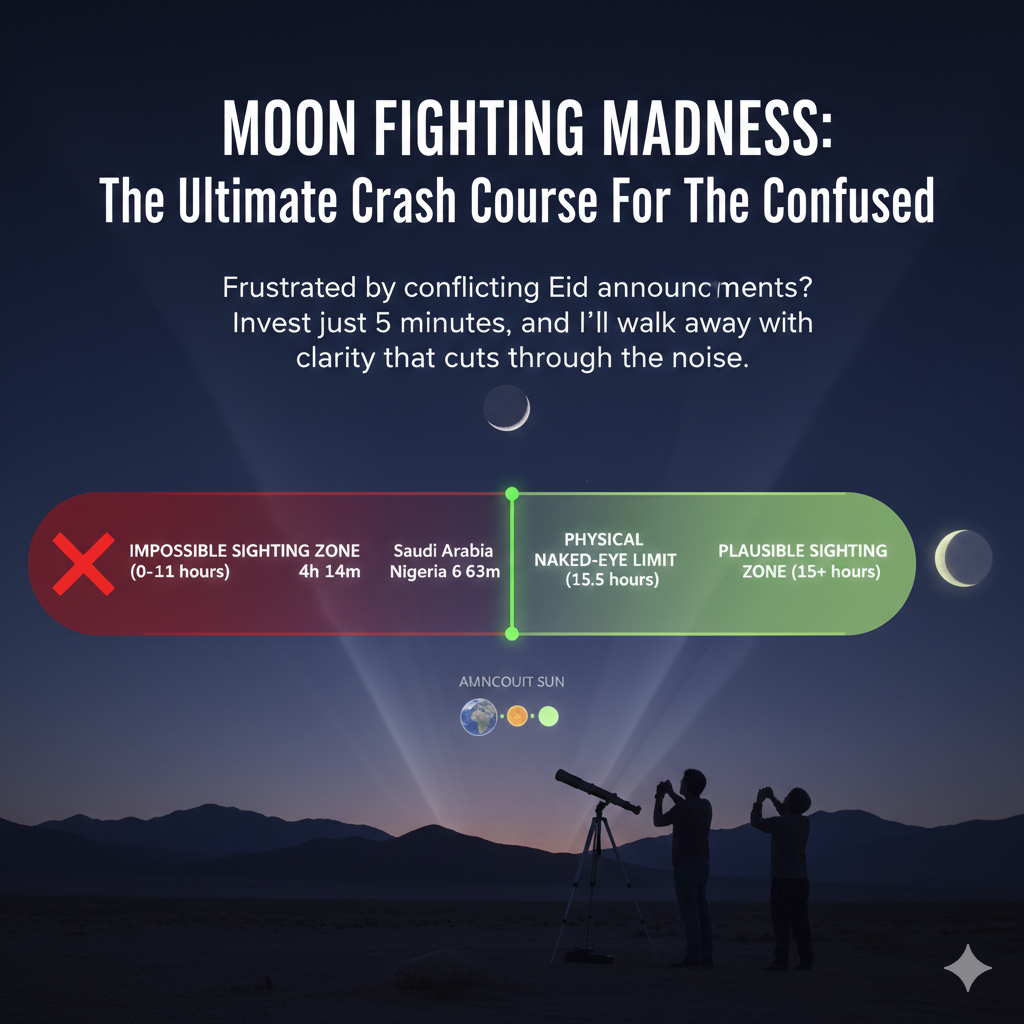
Then look up the records for youngest moon sighting. If someone beats that record by a small margin, it might be plausible. But when someone claims to have seen the moon just 4 hours after conjunction (when the record is 15.5 hours), that’s not just breaking the record – it’s completely shattering what’s physically possible.
Crescent Hunting: A Centuries-Old Sport
After conjunction, it becomes a waiting game – and a competitive one at that. Think of conjunction as the starting line of a marathon, but an incredibly challenging one. Imagine a race where:
* The starting gun (conjunction) marks the official beginning
* Runners (moon observers) can only start moving after a significant time has passed
* The finish line is spotting that first tiny sliver of moon
Throughout history, astronomers, religious observers, and enthusiasts have engaged in what amounts to a sport: crescent hunting.
The Goal of the Sport
The goal? To spot the youngest possible crescent after conjunction.
Here’s how this “sport” works:
- Observers position themselves at various locations around the world
- They select optimal viewing conditions – clear skies, high elevation, good weather
- They use their best visual acuity and sometimes optical aids
- They record exactly when they first spot the crescent
- They verify their observation with photographs when possible
- They document the moon’s age at the time of sighting (hours since conjunction)
Factors Observers Can Control
Over centuries, these “athletes” have pushed the limits of what’s possible. Some factors they can control:
- Elevation: Going to a mountaintop gives a slight advantage (reduces atmospheric interference)
- Location: Choosing places with consistently clear skies and low pollution
- Visual acuity: Having exceptional eyesight or using optical aids
- Technique: Using proper scanning methods and eye techniques
Factors Beyond Anyone’s Control
But the factors they cannot control are far more dominant:
- Moon age: The hours elapsed since conjunction
- Moon-sun elongation: The angular separation between moon and sun
- Crescent width: How thick the illuminated portion appears
- Atmospheric conditions: Even perfect human vision has limits
The Records After Centuries of Competition
After decades of competition and thousands of attempts under optimal conditions, we know the records:
- The youngest moon ever reliably seen with the naked eye: about 15.5 hours after conjunction
- The youngest moon ever seen with optical aid: about 11.5 hours after conjunction
Now imagine someone claims they saw the moon just 4 hours after conjunction. That’s like claiming to have run a 100-meter dash in 2 seconds when the world record is 9.58 seconds. It’s not just unlikely – it’s beyond the limits of what’s physically possible.
Eclipse Predictions: Our Proof of Precision
The Eclipse Experience We All Share
Remember the last solar eclipse? Maybe you even went out to buy those special black glasses to safely watch it. You probably heard on the news that “the eclipse will reach totality in Dallas at exactly 1:40 PM” or something similar.
How Do They Know With Such Precision?
Have you ever wondered how they know that with such precision? How can astronomers predict years in advance exactly when and where an eclipse will happen down to the minute?
It’s because solar eclipses happen only at conjunction – the exact moment when the moon passes between Earth and sun.
A Remarkable Track Record
The fact that eclipse predictions are consistently accurate proves that we can calculate conjunction time with incredible precision.
For example, astronomers predicted that on April 8, 2024, a total solar eclipse would begin in Dallas, Texas at precisely 1:40:38 PM. And that’s exactly when it happened – not a minute early, not a minute late.
Verified Through Direct Observation
This means we can verify conjunction calculations with 100% certainty. When astronomers say “conjunction will occur at 2:24 PM on Wednesday,” we don’t have to take their word for it. We’ve confirmed these calculations countless times through eclipse predictions.
What This Means for Impossible Sightings
So when someone claims to have seen the moon just 4 hours after conjunction, it’s not a matter of opinion whether that’s possible. It’s like claiming to see through a solid brick wall – physically impossible based on everything we know about how the world works.
The “Present But Invisible” Principle
One common misconception is the idea that “if the moon is above the horizon, it must be possible to see it. Okay, maybe highly improbable at best.” This simply isn’t true.
Everyday Things That Are in Our Field of Vision Yet Invisible
Consider these examples of things that are physically present but impossible to detect:
- Single Eyelash in an Olympic Pool: Try spotting a single black eyelash floating in an Olympic-sized swimming pool at midnight from the bleachers. The eyelash exists, but it’s physically impossible for human eyes to detect.
Water Level Change: Attempt to detect if someone removed a single cup of water from an Olympic swimming pool just by looking at it. The water level difference exists, but it’s far too small for human perception.
Microscopic Surface Differences: Imagine trying to see the difference in height between 999 sheets of paper and a stack of 1000 sheets, when viewed from across a room. The difference exists, but it’s beyond human visual acuity.
These examples illustrate a crucial point: visibility isn’t just about an object’s existence, but about the limits of human perception. Just like these examples, a very young moon can exist physically while remaining completely undetectable to human vision.
Observable Facts vs. Scientific Theories
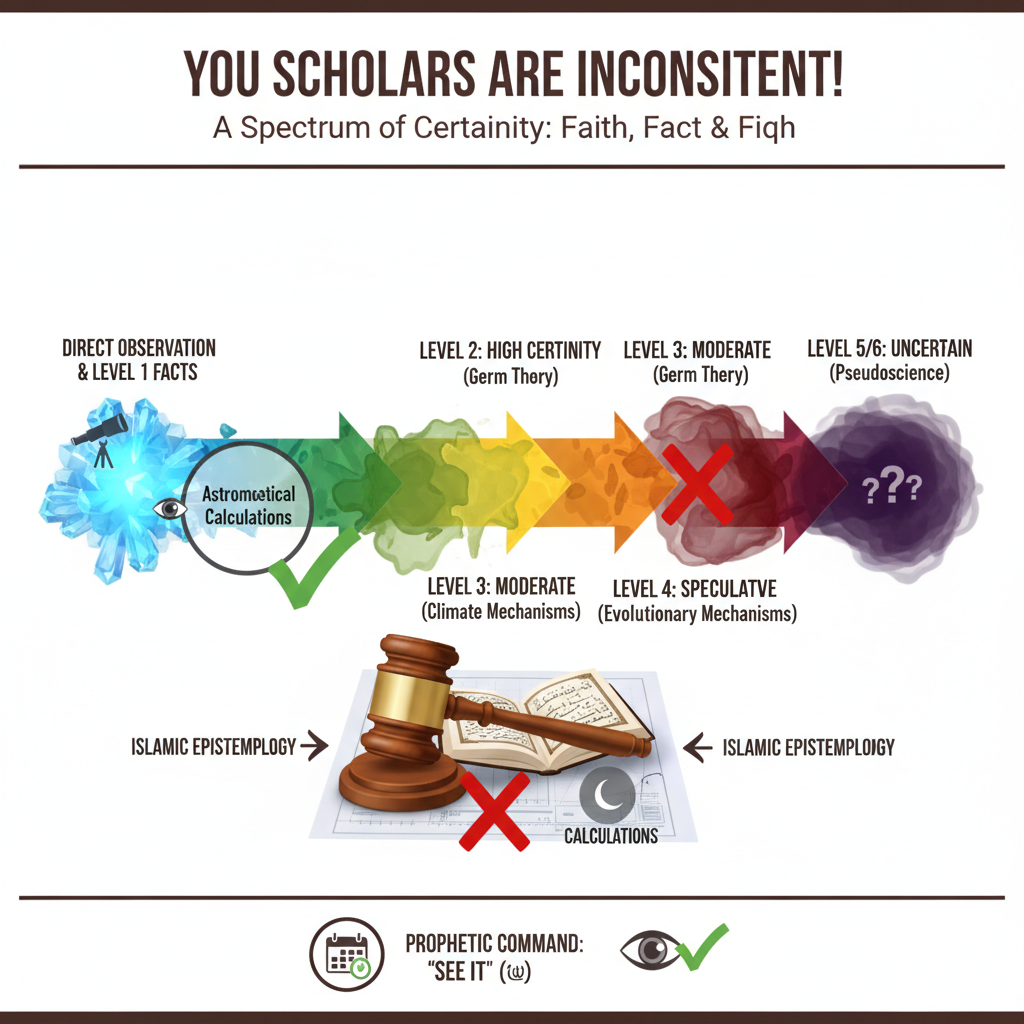
Some people ask: “Why accept astronomy for moon sightings but reject science for other topics like evolution?”
This question helps us understand an important distinction. What we’re dealing with here isn’t “science” in the theoretical sense – it’s direct observable fact:
Two Different Levels of Certainty
- Observable Facts (like conjunction time):
- Can be directly verified through our senses
- Are consistently confirmed by repeated observations
- Don’t change with new discoveries
- Are based on straightforward measurements
- Give the same results regardless of who measures them
- Would require a miracle (suspension of natural laws) to be wrong
- Scientific Theories (like evolutionary theory):
- Involve interpretation of indirect evidence
- Include assumptions that can’t be directly tested
- Change regularly as new evidence emerges
- Include competing models and interpretations
- Involve complex chains of reasoning
- Could be revised or replaced without requiring miracles
We Aren’t Telling You to Trust All Science
We are definitely NOT telling you to trust all science. Much of science is subject to change and speculative. When scientific theories conflict with something definitively established in the Quran and Sunnah, we must reject the scientific theory because the epistemological weight of something definitively established in Quran and Sunnah is higher.
Conjunction time, however, is an observable fact, like “water is wet” or “the sun rises in the east.” Unless Allah fundamentally alters the laws of the universe, these facts don’t change. This isn’t about accepting “science” – it’s about acknowledging what we can directly observe and verify about Allah’s creation.
Think of it this way: If I drop an apple, it will fall down, not up. This isn’t a “scientific theory” that might change tomorrow – it’s an observable fact about how Allah created our world.
Experts in Islamic Tradition
Islamic scholarship has always recognized the need for specialized knowledge:
- For determining if a medicine is halal, scholars consult pharmacological experts
- For calculating complex inheritance cases, scholars often consult mathematics experts
- For evaluating if a financial transaction is permissible, scholars consult financial experts
This isn’t optional – there are entire areas where a scholar cannot issue a valid fatwa without either being an expert themselves or consulting experts in that field. That’s why we have specialists in Islamic finance, medical fiqh, and other technical areas.
If we rejected the principle of trusting experts in their fields, how could you follow a madhhab? How would you know which meat is halal? How would you calculate your zakat correctly?
What makes astronomical calculations special is that we can verify their accuracy ourselves. Every solar and lunar eclipse confirms that these calculations are correct.
Scholars Already Use Knowledge of the Natural World
Scholars already use basic understanding of the world to evaluate testimony:
- If someone claimed they saw the new moon on the 15th day of the Islamic month (when the moon is full), would any scholar accept this? No!
If someone claimed they in an Islamic court that they saw a person the defendant in two places at once, would the Qadhi accept this testimony? No!
Scholars have always used basic knowledge about the world to evaluate whether testimony makes sense. And testimony is not some untouchable concept that magically becomes unquestionable. The rules that govern any type of testimony in an Islamic court govern this type of testimony as well.
Is Understanding This Difficult?
The knowledge needed to evaluate basic moon sighting claims is remarkably simple:
- When did conjunction occur? (Verifiable through eclipse predictions)
- How many hours after conjunction was the claimed sighting?
- Is this time within the realm of what’s physically possible based on records and other things like knowing if the moon is below the horizon? (Things that are calculable with 100% precision)
Most middle school students learn about the moon’s phases. Anyone can understand that a very young, thin crescent is harder to see than an older, thicker one. This isn’t advanced astronomy – it’s basic knowledge about the world Allah created.
What Do You Think?
Consider these questions:
- If someone claimed to have run a 100-meter dash in 2 seconds (when the world record is 9.58 seconds), would you automatically believe them?
If someone claimed to have held their breath underwater for 2 hours (when the world record is about 24 minutes), would you believe them?
Is a claimed moon sighting within the realm of what’s physically possible based on records, moon age, and other factors like horizon position that are calculable with 100% precision?
Common Sense and Physical Limitations
Imagine these scenarios:
* Running a 100-meter dash in 2 seconds
* Holding your breath underwater for 2 hours
* Claiming to see a moon just 4 hours after its astronomical beginning
Each of these claims shares a common thread: they contradict what we know is physically possible. Just as we wouldn’t accept impossible athletic feats, we shouldn’t accept moon sighting claims that defy the physical capabilities of human vision.
Bridging Tradition and Observable Reality
This isn’t about choosing between religion and science. It’s about using the full range of tools Allah has given us:
* Religious principles of testimony and evidence
* Observable facts about the universe
* Intellectual honesty in evaluating claims
The earliest Muslims were astronomical pioneers precisely because they understood that studying the heavens deepens our appreciation of Allah’s creation.
Conclusion: Understanding Moon Sighting Principles
Evaluating moon sightings is about understanding physical possibility. Just as we reject impossible claims like running a 100-meter dash in 2 seconds, we must apply the same standard to moon sighting claims that defy natural laws.
You Don’t Need To Be An Expert
You can know something as basic as the water cycle without being a full blown hydrologist. You can know the heart has four chambers without being a cardiologist. Similarly, you can understand the basic facts required to know a sighting was impossible without being an astronomer.
The Fundamental Truth
Only those who fundamentally do not understand the basic phases of the moon, those who needlessly complicate simple matters, or those too lazy to learn would reject these principles. This approach simply applies the same rigorous reasoning Islamic scholars use in other fields of expertise.
Key Takeaways
- Simplicity Matters: Evaluating moon sightings requires basic understanding, not advanced knowledge.
- Facts are Verifiable: Conjunction time can be checked by anyone.
- Physical Limits are Real: Human vision has clear, measurable boundaries.
- Honesty is Crucial: Faith appreciates the precision of Allah’s creation.
Understanding comes from carefully examining evidence. This is about maintaining the intellectual integrity that has always defined Islamic scholarship.