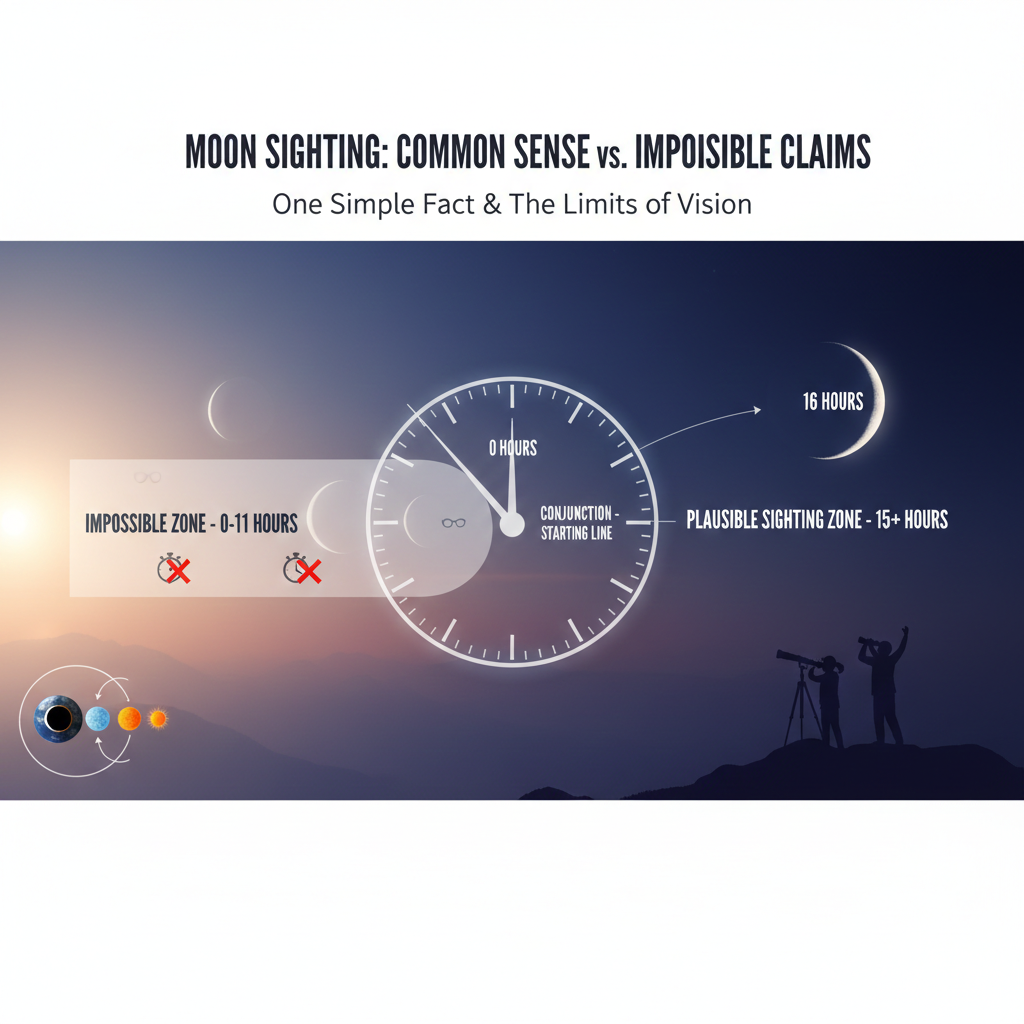
Let me begin by saying I’m genuinely surprised this objection comes up as often as it does. I hope this explanation helps clarify why these categories are fundamentally different – and why distinguishing between them matters for our religious practice.
The Objection
Some people argue:
“Since both prophetic miracles (mu’jizat) and impossible moon sightings are practically impossible, rejecting these moon sightings on grounds of practical impossibility would logically require rejecting prophetic miracles too. You can’t accept one impossible thing while rejecting another.”
Others go further:
“This land is holy, and in holy lands, miracles are expected. Therefore, these “impossible” moon sightings are miracles.”
Why This Objection Fails
If this reasoning were valid, the consequences would be not just unscientific but dangerously irrational. Here’s why:
- Every strange claim becomes credible
If a person says they saw someone flying in Detroit, you’d have to accept it—since the Prophet ﷺ flew during the Night Journey. Medical standards collapse
A 90-year-old man claims he’s pregnant? Doctors would have to accept it—because hey, miracles happen, right?Legal testimony loses credibility
A witness says, “The murdered man is alive and well—I saw him yesterday!” Courts would have to accept that too.Science becomes meaningless
The core of scientific inquiry—repeatable, measurable observations—vanishes. Every failed experiment could be waved off with “it was a miracle.” Research, innovation, and medicine would stagnate.Justice systems would collapse
In a world where “miracles” are regularly invoked:- A thief could say, “The money just appeared in my house—miraculously.”
- A fraudster might claim, “The documents I signed changed miraculously.”
Courts would have no objective grounds for judgment if “miracle” claims bypassed evidence.
At the heart of this flawed logic is a failure to distinguish between two very different domains:
- Divinely reported miracles – backed by revelation and mass transmission (tawātur).
- Natural phenomena – like the moon’s visibility, which follow observable, physical laws and are integral to our fiqh (legal) practice.
You Don’t Have to Believe Every Supernatural Claim
Yes, we believe in miracles. But that doesn’t mean we must accept every claim that something miraculous occurred. Islam is very rational at its core: miracles are rare, purposeful events—not loopholes in logic or evidence.
Understanding Different Types of Miracles
Islam recognizes two main categories of supernatural events:
Prophetic Miracles (mu’jizat):
– Given to prophets as proof of their message
– Reported in the Quran and authentic hadith
– Serve to establish divine authority
– Examples: splitting of the moon, the Quran itself
Saintly Miracles (karamat):
– Can happen to righteous believers
– Not meant to establish religious authority
– Personal in nature
– Example: provision from unexpected sources
While both types are logically possible (Allah can do anything), we don’t automatically accept every claim of a miracle without evidence or purpose.
Islamic Legal System And Miracles In Due Process
While belief in the possibility of miracles is part of our faith, Islamic courts do not accept miracle claims as legal proof. Here’s how this principle applies:
- Testimony is grounded in known reality
A trustworthy person claiming they were in two places at once isn’t accepted just because they’re righteous. Physical impossibility matters. - Due process demands consistency
Laws must apply equally. The second we allow “miraculous exceptions,” justice becomes arbitrary. - Moon sightings are treated like any other testimony
Just as courts examine evidence in theft or murder, they also examine whether moon sighting claims align with known visibility data. - Saintly Miracles (Karāmāt) are not admissible in court
While respected spiritually, they’re not usable as legal proof, because they’re exceptions to natural law—not its standard.
So: if someone can’t get away with “the money appeared miraculously in my home,” then neither can a moon sighting bypass basic empirical standards.
This isn’t a denial of miracles. It’s a framework that preserves the reliability of the legal system and protects against exploitation.
Allah’s System for the Moon
Allah says in the Qur’an:
“And the moon – We have determined for it phases…”
(Surah Yā Sīn 36:39)
In other words, the moon was created with order, phases, and predictability.
The lunar system was designed to be simple, observable, and universally accessible—not mystical, hidden, or reserved for a chosen few.
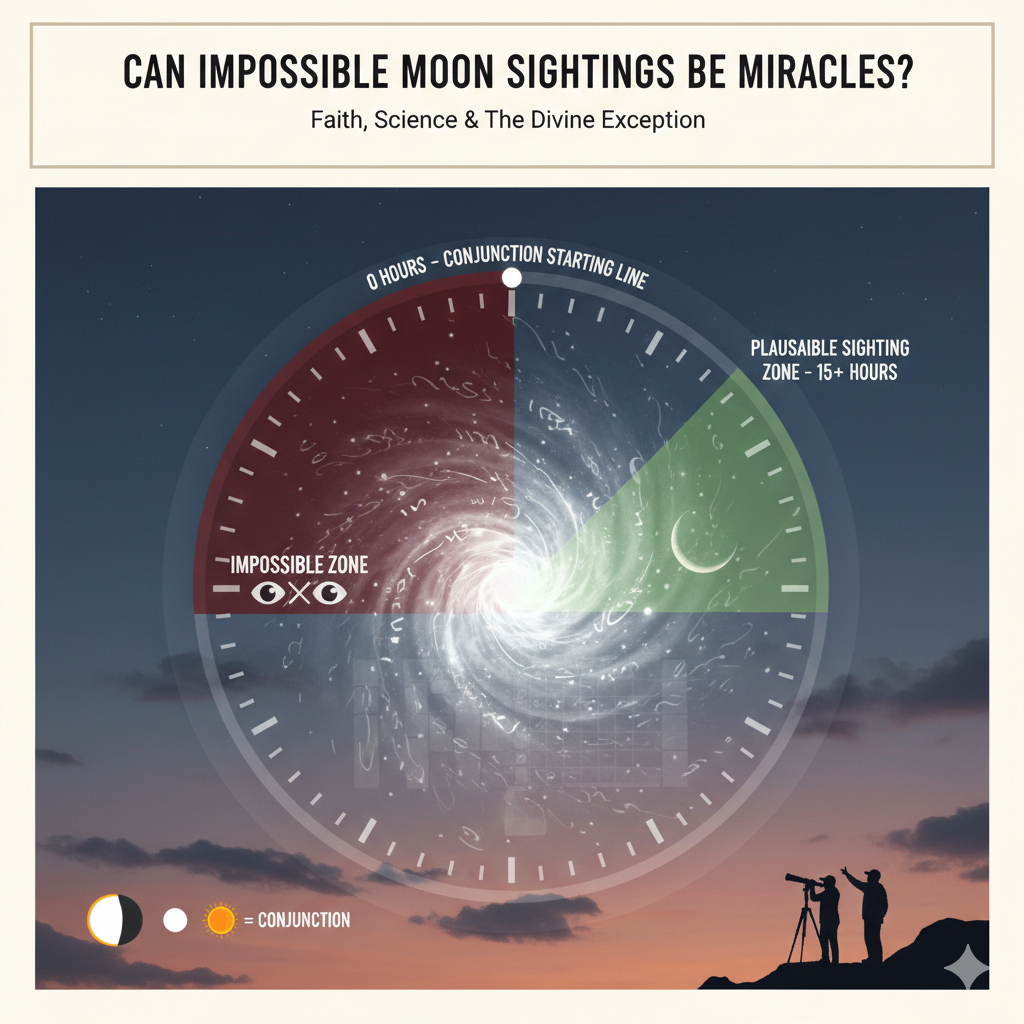
Could These Impossible Sightings Be Miracles?
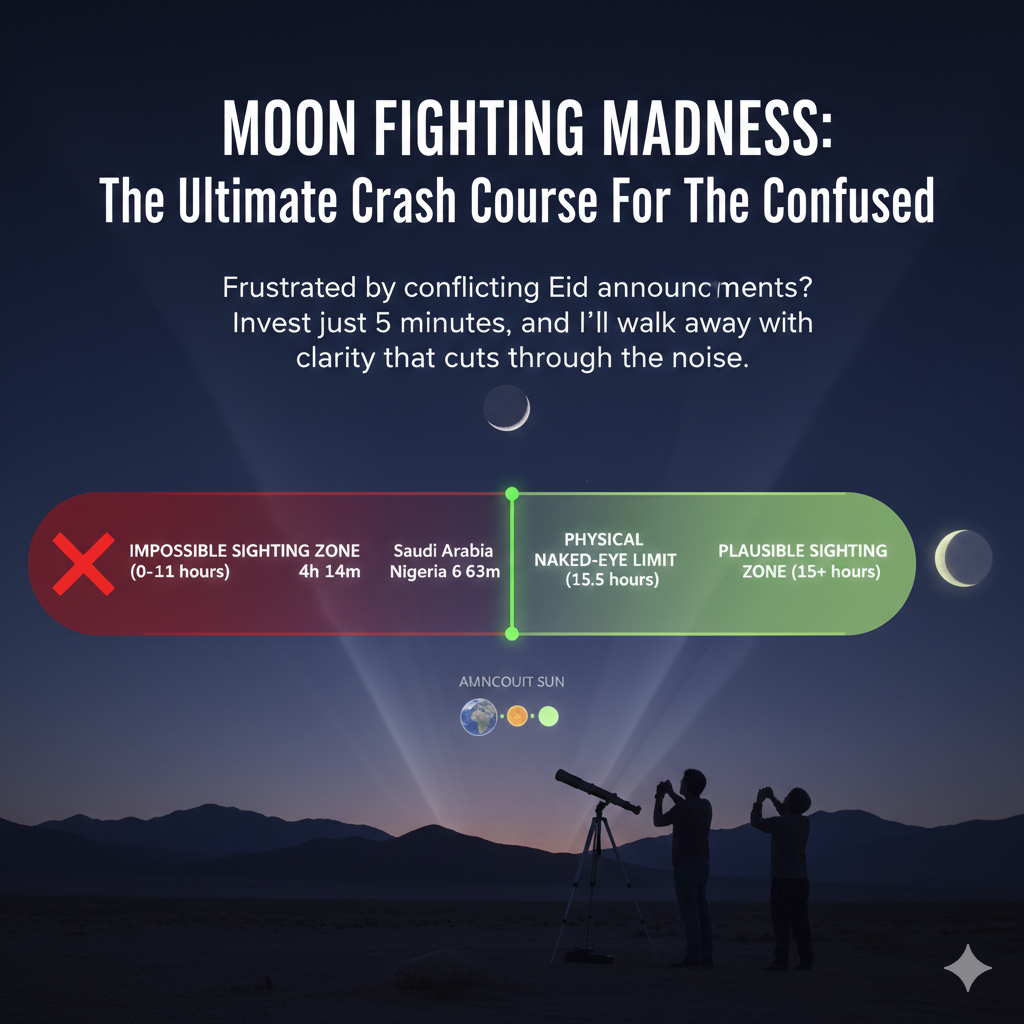
I’m not saying these impossible sightings cannot be miracles in an absolute sense. Allah is certainly capable of making a 2-hour-old crescent visible if He willed. However, there are compelling reasons to believe they are not miracles:
- Miracles serve clear purposes – They demonstrate divine truth or support prophetic claims. What religious purpose would be served by making an invisible crescent visible to some observers but not others, creating division in the ummah?
- Miracles are recognized exceptions to established patterns – Their extraordinary nature depends on the stability of the natural order they temporarily suspend. If the natural system is regularly broken, then nothing is truly miraculous.
- The miracle framework requires stability – For something to qualify as breaking the customary pattern, we need a stable customary pattern to begin with. If natural laws were routinely suspended for lunar visibility, then seeing young crescents wouldn’t be miraculous – it would just be part of an unpredictable system.
Miracles Don’t Follow Predictable Patterns
These “impossible” sightings follow distinct patterns that suggest natural, not supernatural, explanations:
– They consistently occur in specific geographic regions
– They happen with predictable frequency
– They correlate with particular institutional affiliations
– They follow similar patterns of testimony
True miracles in Islamic tradition don’t show such predictable sociological and institutional patterns.
Absolutely. Here’s the full, polished section integrating your original content, kalāmī framing, light-hearted tone, and the improved example—all crafted for both accessibility and depth:
Miracles Don’t Follow Predictable Patterns
These so-called “impossible” moon sightings follow distinct patterns that strongly suggest natural or human factors, not divine intervention. Over the years, they have:
- Consistently occurred in specific geographic regions
- Happened with remarkable regularity
- Aligned with certain institutional or political calendars
- Involved similar lone-witness testimonies, often uncorroborated
In short: they resemble human behavior far more than divine action.
True miracles in Islamic tradition don’t show such predictable sociological and institutional patterns.
When Allah breaks the natural order (kharq li’l-ʿādah), it’s not bound by geography, politics, or administrative habit. A real muʿjizah or karāmah is striking, exceptional, and above patterns—not part of one. It comes unannounced, not on schedule. It amazes everyone, not just those with insider knowledge. The moment you can predict when and where the next “miracle” will happen—with uncanny accuracy—it stops looking like divine intervention and starts looking like a recurring event.
When Predictions Come True
This predictability hasn’t gone unnoticed. In fact, it’s become so routine that scholars have started predicting it with pinpoint accuracy—even jokingly.
Two complete days before the reported “impossible” sighting of March 29, 2025, Shaykh Mateen Khan posted a sarcastic survey on March 27th, poking fun at how routine these events have become:
Survey: Will Saudi sight the moon on Saturday night?
[ ] Yes, they have the eyes of the desert eagle.
[ ] Yes, they have the foresight to see the next day’s hilal.
[ ] Yes, Shaykh al-Cataract is a reliable lone narrator.
[ ] Yes, any Ashʿarī knows it’s not intrinsically impossible.
[ ] No, they won’t sight it… haha, j/k, of course they will.
This wasn’t just a joke—it was a prediction. A rhetorical wink that said: Of course the sighting will happen. It always does. Right on cue. And sure enough, it did.
Let that sink in.
If a supposed miracle can be predicted in advance—with sarcasm and accuracy—then by definition, it no longer functions as a miracle. Divine miracles in Islam aren’t part of anyone’s yearly calendar. No one says, “Better set a reminder—gravity is going to reverse this Friday.” Or, “Watch closely—water’s turning into fire at sunset.”
When your miracle fits neatly into a recurring schedule, comes with a flyer, and can be memed a week before it happens—it’s not a miracle. It’s a program.
And patterns—especially ones that sync with national interests or astronomically calculated lunar calendars—are precisely what miracles were meant to disrupt.
The “Miracle” Would Undermine Its Own Purpose
The purpose of the lunar calendar is to create unity and clarity. A moon that shows up only in select locations undermines:
- The global applicability of Islamic dates
- The ease and accessibility of moon sighting
- The very point of a simple system for the masses
Why Consistent Natural Laws Matter
Allah gave us natural laws for a reason: so we can recognize His power when He does break them. If nature were unpredictable:
- We couldn’t spot true divine signs
- Religious rituals would become chaotic
- The miraculous would be indistinguishable from the mundane
- The Qur’an’s appeal to nature as a sign of Allah’s wisdom would lose meaning
Potential for Exploitation
Throughout Islamic history, false claims of supernatural abilities have been used to:
- Gain undue religious authority
- Extract financial benefits from followers
- Justify deviations from established religious practices
- Escape accountability through claims of special status
Islamic scholars and judges have always emphasized caution: affirm the possibility of miracles, but be skeptical of specific claims.
A Balanced Approach
Islam teaches us to be balanced in our approach:
- We affirm Allah’s power to cause any miracle He wills
- We recognize the wisdom in Allah’s consistent natural systems
- We evaluate claims based on appropriate evidence
- We consider the purpose and wisdom behind claimed supernatural events
This balanced approach protects both our belief in true miracles and the integrity of our religious practices.
Conclusion
The moon splitting was a true miracle precisely because it was an exceptional departure from the otherwise consistent celestial order Allah created. The regular lunar cycle, by contrast, was designed as a predictable system for all believers to follow.
By maintaining these distinctions, we honor both Allah’s power to perform miracles and His wisdom in establishing consistent natural patterns for our religious practice.