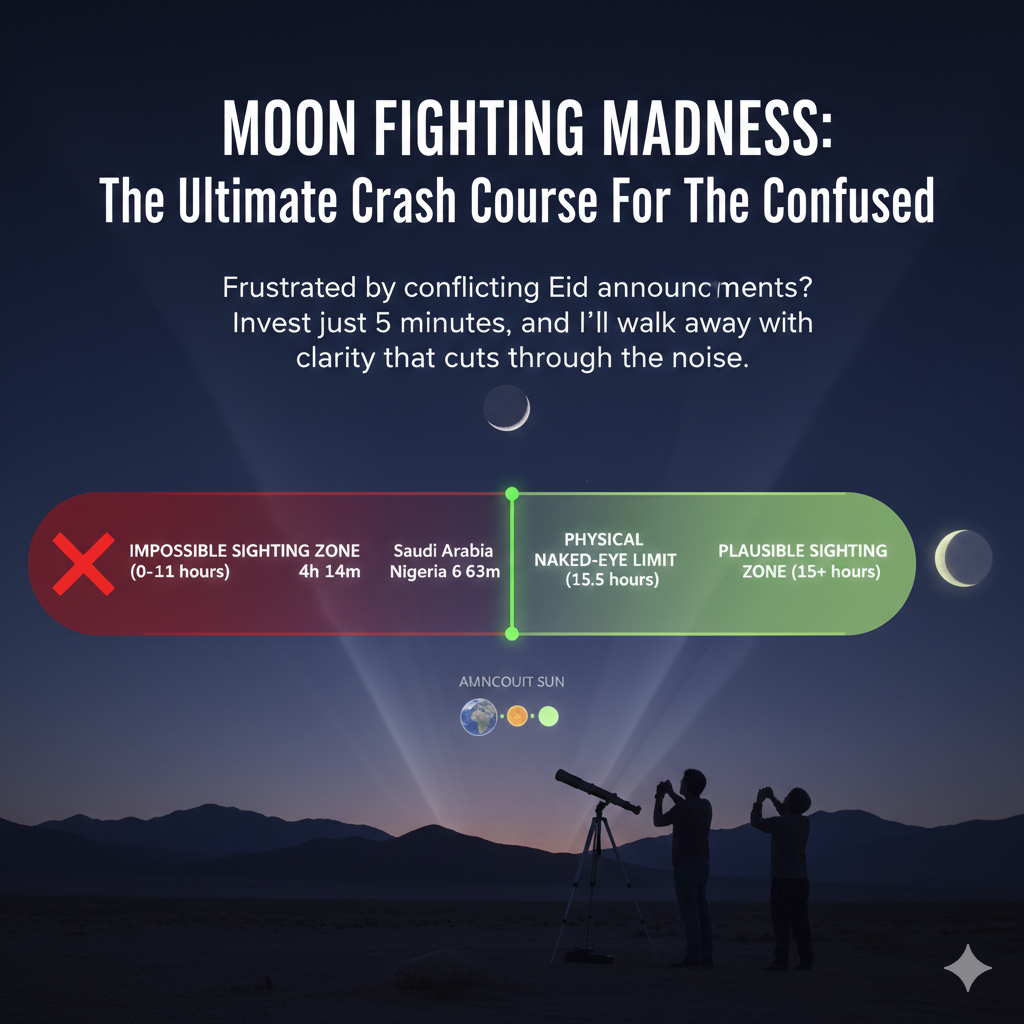
Frustrated by conflicting Eid announcements? Invest just 5 minutes, and you’ll walk away with clarity that cuts through the noise. This isn’t just another article – this is your key to understanding it all.
Introduction
If you’re reading this, you’re likely a Muslim in the USA. You might be a board member or Imam of a Masjid or leader of a household feeling the weight of making the correct decision.
This article offers a straightforward explanation of the moon sighting controversy from March 29, 2025 – perfect for anyone seeking to understand this issue without needing technical knowledge or expertise. Whether you’re completely new to this topic or just looking to clear up common misconceptions, this guide aims to provide all the information you need in one place.
Let’s explore the million dollar question: Could observers in Sokoto (Nigeria), Tumair (Saudi Arabia), and Kabul (Afghanistan) have seen the new moon on March 29, 2025, as has been claimed? Scientific evidence indicates this would be physically impossible, raising important questions about these reported sightings.
The Moon Visibility Basics
For a new moon to become visible, several factors need to align:
- The moon needs to be old enough since birth (conjunction)
- It needs to be far enough away from the sun’s glare
- The crescent needs to be wide enough to reflect sufficient light
- It needs to remain above the horizon after sunset
- The sky conditions need to be favorable
Think of it as trying to spot a silver needle – you need the right light, the right angle, and the right timing, or you’ll miss it completely!
The Claims vs. Scientific Reality
Reported Sightings
People claimed to see the crescent moon on March 29, 2025, in:
– Sokoto, Nigeria (moon age: 6h 53m)
– Tameer, Saudi Arabia (moon age: 4h 14m)
– Kabul, Afghanistan (moon age: 2h 47m)
What Science Says
According to carefully documented records:
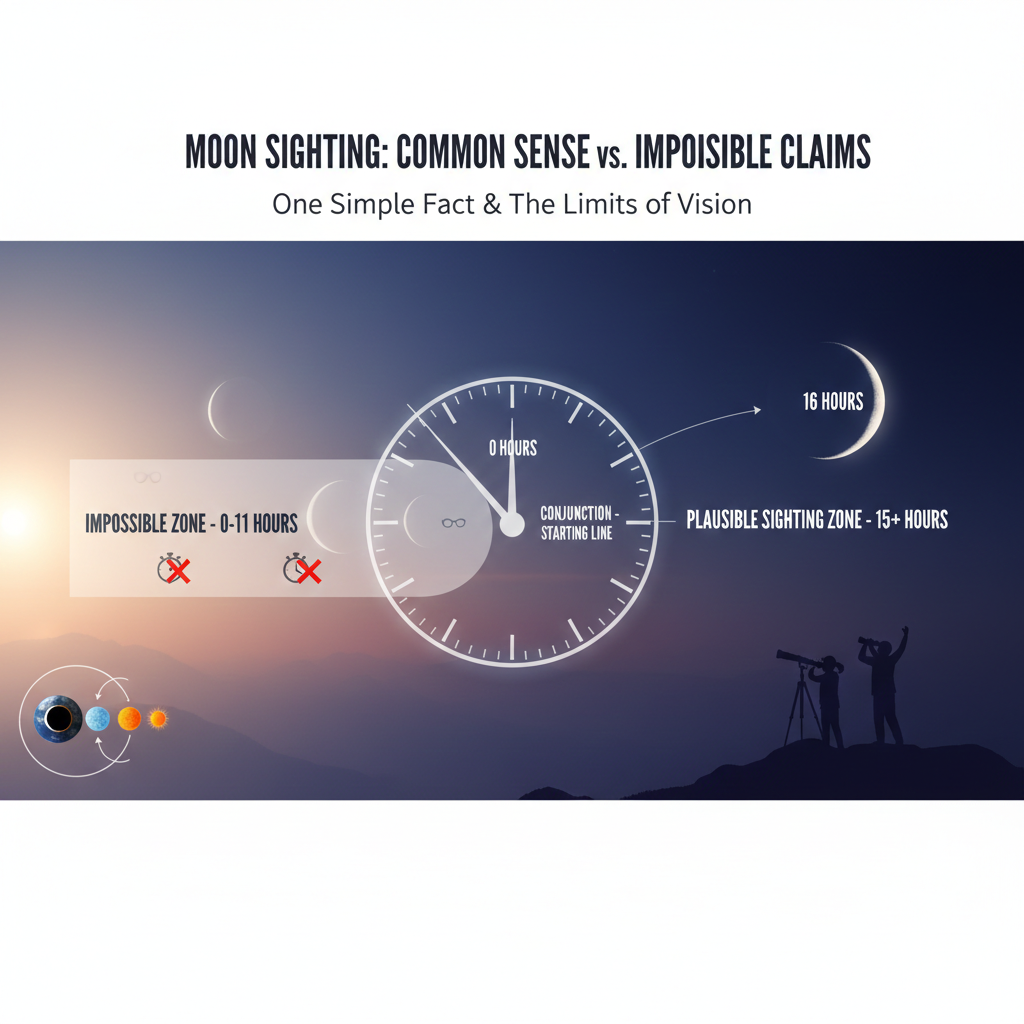
- The youngest moon ever reliably seen with the naked eye was about 15 hours 32 minutes old
- The youngest moon observed using binoculars was about 11 hours 40 minutes old
This means the reported sightings were of crescents 2-5 times younger than the best-ever documented observations (Schaefer et al., 1993). That’s quite the astronomical achievement!
Understanding Practical Impossibility vs. Mere Improbability
Many people might think, “Well, it’s just very unlikely, but still possible with good eyesight or the right equipment.” This misunderstands the distinction between:
Mere Improbability: Something that’s rare but could happen with luck or skill. Example: Drawing a royal flush in poker. Unlikely, but happens regularly somewhere in the world.
Practical Impossibility: Something that violates physical limitations to such a degree that it cannot realistically occur. Example: Jumping 50 feet high unaided by equipment.
The moon sightings on March 29 fall firmly in the “practically impossible” category because:
- The crescent was too thin to reflect enough light to be visible (like trying to see a strand of hair from a mile away)
- The moon was too close to the sun’s glare (like trying to spot a candle flame next to a spotlight)
- The required visual acuity would exceed the physical limitations of the human eye by several times
No amount of perfect conditions, excellent eyesight, or even standard telescopes can overcome these physical limitations. This isn’t about probability – it’s about the physical limits of light reflection, atmospheric diffraction, and human visual perception.
Even the world’s most advanced telescopes would struggle to detect a crescent this young – and claims of seeing it with the naked eye or binoculars go beyond what’s physically possible, not just what’s improbable.
Don’t Use Astronomical Calculations To Negate Testimony? Wrong.
Yes, you do.
Even those who claim to reject astronomical calculations end up relying on them — just selectively.
Imagine someone came forward on the 27th night of Ramadan claiming to have sighted the new crescent. Would these same individuals accept it? Of course not. Why? Because everyone knows the moon can’t be seen that early. And how do we know that? From the very same astronomical data they claim to disregard.
The same science that tells you the moon is definitely not visible on the 27th is also telling you it was impossible to sight the crescent on the 29th of March, 2025.
Just because one is easier to understand doesn’t make it more true than the other.
Algebra and Calculus are just as definitive as 2 + 2 = 4 even if they take longer to understand.
You can’t pick and choose. Either the data is reliable, or it isn’t.
Putting This in Perspective
The Sports Record Analogy
Imagine someone claiming to run 100 meters in 3 seconds when Usain Bolt’s world record stands at 9.58 seconds. We’d be asking if they teleported or had rocket boosters in their shoes! The moon sighting claims represent an even bigger leap – it’s like claiming to swim across the English Channel in 30 minutes when the record is over 7 hours, without growing fins or befriending a dolphin.
The Visual Challenge
Seeing a 2-7 hour old crescent is like:
– Trying to spot a single eyelash floating in an Olympic swimming pool… at midnight… from the bleachers
– Reading the fine print on a candy wrapper from a quarter-mile away
– Finding a specific snowflake in an avalanche
– Hearing a whisper from across a crowded football stadium
It’s not just difficult – it’s in the realm of “good luck with that!”
What Might Explain These Reports?
Scientific research offers several insights into why sincere observers might report seeing an impossible lunar crescent:
- Misidentification of celestial objects: Other bright objects like Venus can look similar to a moon crescent from certain angles.
Atmospheric phenomena: Sky conditions can create misleading light patterns that resemble a crescent shape.
Expectation bias: People’s strong expectations can make them perceive what they want to see, especially in culturally significant moments.
Social and institutional pressure: Group expectations can unconsciously influence individual observations and testimonies.
Inaccurate testimony: While most reports are well-intentioned, some may be influenced by unspoken institutional or political motivations.
These explanations align with documented patterns of perception and testimony, offering plausible alternatives to physically impossible astronomical observations.
The why would they lie argument?
Facts First, Motives Second.
When someone asks, “Why would anyone claim to see the moon that wasn’t there?” they’re skipping a crucial first step.
This is like a detective who, when shown blood evidence, fingerprints, and security footage of a suspect committing a crime, says: “But this suspect seems like such a nice person – why would they do this? Let’s ignore all that evidence.”
A more logical approach would be:
1. Examine the physical evidence to determine what actually happened
2. Only after establishing the facts, consider questions of motive or intention
The physical laws of astronomy don’t change based on human character or intentions – they’re consistent whether we understand someone’s motivations or not.
Why Use Science to Negate Moon Sightings But Not to Establish Them?
This approach is grounded in fundamental principles of Islamic legal interpretation:
Preserving the Prophet’s Clear Instructions
The Prophet Muhammad ﷺ instructed: “Fast when you see it (the crescent) and break your fast when you see it…” (Bukhari and Muslim). The word “see” (ru’yah) clearly refers to visual observation with the human eye.
The Importance of Apparent Meanings
Taking words at their apparent meaning (dhaahir) is essential in Islamic textual understanding. If we decide “seeing the moon” actually can mean “calculating the moon’s position,” we open a dangerous door that undermines not only the entire foundation of Islamic practice but also the basic function of human language itself.
Scholars who insist on the literal meaning of “seeing” in this context aren’t merely being rigid about one particular issue – they are defending a fundamental interpretive principle that protects the entire religion. This principle of adhering to the apparent meaning of texts (haqiqah) unless compelling evidence indicates otherwise is what preserves the integrity of Islamic law and practice across all domains.
Consider how arbitrary reinterpretation undermines clear communication:
- If a legal document says “sign on the dotted line,” would you consider typing your name elsewhere or drawing a star symbol to fulfill this requirement? Of course not! The word “sign” clearly means writing your signature in the specific indicated location.
When a warranty states “proof of purchase must be presented for all returns,” would any store accept that you simply described your purchase experience verbally without showing a receipt? The meaning of “presented” obviously requires physically showing the document.
If a medical consent form states “patient must initial each page,” would any doctor accept mathematical calculations about your name instead of your actual handwritten initials? This would completely change what’s being requested.
When a tax form instructs you to “attach W-2 form here,” would the IRS consider it compliance if you merely calculated your income without including the actual document? The instruction clearly calls for the physical document.
These examples show how replacing the apparent meaning with an alternative interpretation fundamentally changes the nature of what’s being asked. Similarly, when the Prophet ﷺ said to “see the crescent,” reinterpreting this to mean “calculate its position” changes a direct sensory instruction into a completely different mental activity.
Consider these examples that show how changing the meaning of a single word transforms religious practice:
- When Allah commands us to “obey the Messenger,” all Muslims understand the word “obey” to mean actually following his instructions as given. If we allowed “obey” to also be interpreted as “consider his advice while making your own judgment,” the entire concept of religious authority would be undermined.
When the Quran instructs Muslims to “lower their gaze,” the word “lower” is understood as physically directing one’s eyes downward away from inappropriate sights. If we reinterpreted “lower” to mean “mentally ignore while still looking,” the physical action explicitly commanded would be replaced with a mere internal attitude.
In the same way, when the Prophet ﷺ explicitly instructed Muslims in the hadith: “Fast when you see it (the crescent) and break your fast when you see it” (صوموا لرؤيته وأفطروا لرؤيته) as reported in Bukhari and Muslim, the word “see” (رؤية/ru’yah) unambiguously refers to visual observation with the human eye. If we allowed “see” in this hadith to also be interpreted as “determine through calculation,” we would be changing the fundamental nature of the command from a physical action (looking with the eyes) to a mental exercise (calculating positions). This would not only contradict the Prophet’s ﷺ clear intent but would open the door to reinterpreting other explicit commands throughout Islamic texts.
Each of these examples shows how changing just one key word’s meaning can fundamentally alter religious practice while seeming to maintain some connection to the original command.
When scholars stand firm on this point, they’re not just defending moon sighting – they’re guarding the methodological foundation upon which our understanding of all Islamic texts is built. If this principle is compromised for convenience in one area, the same logic can be applied elsewhere, gradually eroding the entire framework of textual interpretation.
This isn’t about being rigid – it’s about being principled and consistent. When we accept arbitrary departures from apparent meaning in one area, we undermine the entire textual foundation of the religion and the very possibility of clear communication.
Islamic Tradition Already Balances Testimony and Facts
Islamic scholarship has consistently evaluated testimony against known physical facts:
1. Implausible Witnessing of Transactions
If a witness testified in Islamic court that they observed the details of a business transaction that took place inside a closed room while they were standing outside the building, the testimony would be rejected. Islamic judges recognize that witnesses cannot see through solid walls, regardless of their character or trustworthiness.
2. Calendar Impossibilities
If witnesses came to an Islamic court claiming they had seen the new crescent moon on the 27th day of the lunar month, their testimony would be dismissed because the moon physically cannot complete its cycle in less than 29 days – a fact acknowledged in Islamic astronomy and legal texts.
3. The Location Question
If a witness testified in court that they saw the same person in Mecca and Medina at the exact same time (when it takes hours to travel between them), the testimony would be rejected because a person cannot physically be in two places at once.
4. Vision Limitations
If a witness in court claimed they clearly saw someone’s face at night from two miles away without any lighting or visual aids, the judge would question this testimony because it exceeds the natural capabilities of human eyesight.
5. Weather Contradictions
If a witness testified they saw someone slip and fall due to heavy rain on a certain day, but weather records, mosque attendance records, and numerous other witnesses confirmed it was actually a clear, dry day, the testimony would be considered questionable despite the witness’s character.
The “It’s On Their Heads” Misconception
Some might say, “So what if witnesses give impossible testimony? Let’s accept it and the sin will be on their heads if they’re lying.”
This misunderstands a fundamental principle in Islamic jurisprudence. Islamic courts cannot knowingly base rulings on physically impossible claims – that would undermine the entire judicial system. Judges have a religious and legal obligation to evaluate testimony against known facts.
In none of the examples above would a qadi (judge) say, “Well, I know you can’t see through walls, or be in two places at once, or see in complete darkness, but I’ll accept your testimony anyway and if you’re lying, that’s between you and Allah.” Such an approach would make Islamic courts meaningless and contradict the Quranic principle of justice based on truth and evidence.
The same principle applies to moon sighting. When testimony contradicts established physical realities, scholars have a responsibility to scrutinize it – not to accuse witnesses of lying, but to protect the integrity of the system that determines religious timings for the entire community.
These straightforward examples show that Islamic courts have always weighed testimony against basic physical facts. The tradition recognizes that even honest people can be mistaken, and testimony that contradicts established physical reality requires careful scrutiny.
What the Experts Say
Multiple independent astronomical organizations have published visibility models and criteria that classify these claimed sightings as impossible:
- His Majesty’s Nautical Almanac Office (UK) – a government scientific body with no religious affiliation – produces global visibility maps showing that the crescent would be below visibility thresholds in these regions on March 29, even with telescopes (Middle East Eye, 2025; HM Nautical Almanac Office, 2025).
The International Astronomy Centre (UAE) – a secular scientific institution – has developed visibility models indicating moon sighting would be “impossible in the eastern parts of the world and unfeasible across the rest of the Arab and Islamic world, even with advanced observation tools” (The Daily Tribune, 2025; International Astronomy Centre, 2025).
NASA – the U.S. space agency – provides astronomical data describing the March 29 new moon as “essentially invisible from the surface” except during solar eclipses (NASA Science, 2025).
The Royal Observatory Greenwich – a centuries-old scientific institution unaffiliated with any religious organization – utilizes astronomical criteria that would classify these sightings as below the threshold of visibility (Middle East Eye, 2025).
The U.S. Naval Observatory – a scientific organization under the Department of the Navy – publishes crescent visibility standards indicating conditions in these locations were far below minimum visibility thresholds (U.S. Naval Observatory, 2025).
These assessments are based on universally applied astronomical principles and visibility models developed through decades of scientific observation and research.
The Subcontinent Scholars Argument: Are They Racist?
Some might wonder, “Are Subcontinent scholars just rejecting Saudi sightings because they always disagree with Saudi or African sightings because they don’t like Africans?” Let’s break this down honestly:
First, these scholars aren’t selectively rejecting Saudi claims. They’ve consistently applied the same scientific and Islamic principles to moon sightings from multiple countries:
- They rejected Saudi Arabia’s claims
- They rejected Nigeria’s claims
- They rejected Afghanistan’s claims
All were rejected for the same fundamental reason: the physical impossibility of seeing the moon at those times.
Also, what motive exists to needlessly reject Saudi sightings. These are sincere attempts to determine the correct Islamic date. The scholars aren’t attacking individuals – they’re protecting the integrity of religious observance by insisting on verifiable, physical evidence.
The real issue isn’t about countries or personalities – it’s about a shared framework of moon sighting that, if not carefully applied, leads to repeated inaccuracies.
The Framework Problem: A Systemic Issue
There’s a deeper concern here. For countries that consistently report impossible moon sightings, the problem isn’t individual dishonesty – it’s a flawed systematic approach. Their current framework lacks a critical step: rigorous verification against scientific observable fact.
Any country that adopts this same approach will inevitably encounter the same issues. It’s not about pointing fingers – it’s about improving our collective method of determining important religious dates.
Who’s Celebrating Eid When?
It’s important to know you’re not alone. Other Arab countries like Jordan, Syria, Egypt, and Oman are observing Eid on Monday, March 31, 2025 despite being the same same area as Saudi Arabia. In the United States, major cities like Chicago and New York are also celebrating Eid on Monday. Communities all around the US are celebrating Eid on Monday. This widespread observance shows that the decision to celebrate Eid on Monday is based on careful consideration and scientific evidence, not isolation.
The Scholar’s Responsibility: Seeking Truth
Scholars have a sacred duty: to seek and uphold the truth, even when it’s uncomfortable. This isn’t about winning arguments or defending reputations. It’s about carefully examining evidence, challenging claims with respect, and guiding the community toward what is most accurate and just. When presented with claims that contradict physical reality, true scholarship demands rigorous investigation and honest reporting.
Are The People Who Celebrated Eid Sunday Excused?
Being excused is another discussion. But let’s be clear: accuracy matters in religious observance. Good intentions do not change fundamental facts. If someone celebrated Eid on Sunday, regardless of their sincerity, they undoubtedly celebrated on the 30th of Ramadan – and the weight of that decision falls on those who made it, especially those in leadership positions.
This isn’t about casting blame, but about maintaining the precision of our religious practice. Sincerity is commendable, but it must be coupled with a genuine commitment to understanding and following the most correct Islamic principles and unifying the community on the correct position, even if it requires a bit of studying.
Conclusion
This isn’t about science versus religion playing tug-of-war. It’s about maintaining the integrity of both. Islamic tradition has always recognized that testimony should make sense in the real world we all share.
When claimed observations fall so far outside established limits—by factors of 2-5 times beyond documented records—they deserve a friendly “Are you sure about that?” conversation.
By acknowledging the physical challenges of these claimed sightings, we’re actually protecting the principle of taking religious texts at their apparent meaning, ensuring that “seeing” remains connected to what human eyes can actually see.
Anyways, whether you’re moonsighting with binoculars, WhatsApp scholars, or just your gut feeling—remember, it’s not madness. It’s tradition, love, and a little bit of chaos stitched together under one sky.
Eid Mubarak. I love you all—genuinely, confusingly, and, yes, to the sighted moon and back.
Previous Articles
Complete Beginner’s Guide
If you’re just getting started and want an easy-to-understand breakdown of this issue, this article is perfect for you:
👉 Moon-Fighting Madness: The Ultimate Crash Course for the Confused
📚 Longer, More Technical Version
If you’re looking for a deeper, more technical breakdown—covering why calculations aren’t the problem and how to handle claims of “impossible” sightings—check out the full article here:
👉 The Non-Problem with Calculations: Say Sighting Was Impossible
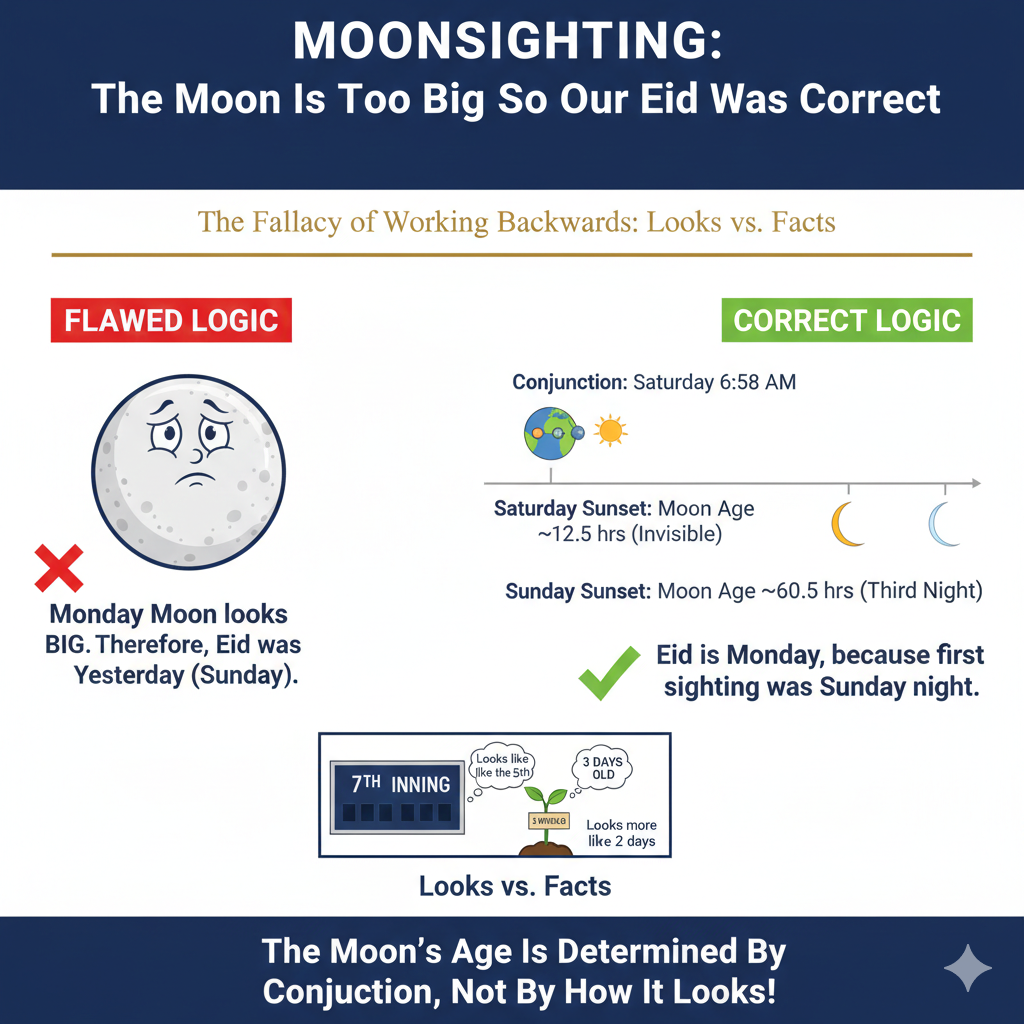
Moon Is Big, So Earlier Eid Was Right
This tackles a common objection that the moon seems big, so the earlier Eid must have been correct.
👉The Moon Is Too Big So Our Eid Was Correct
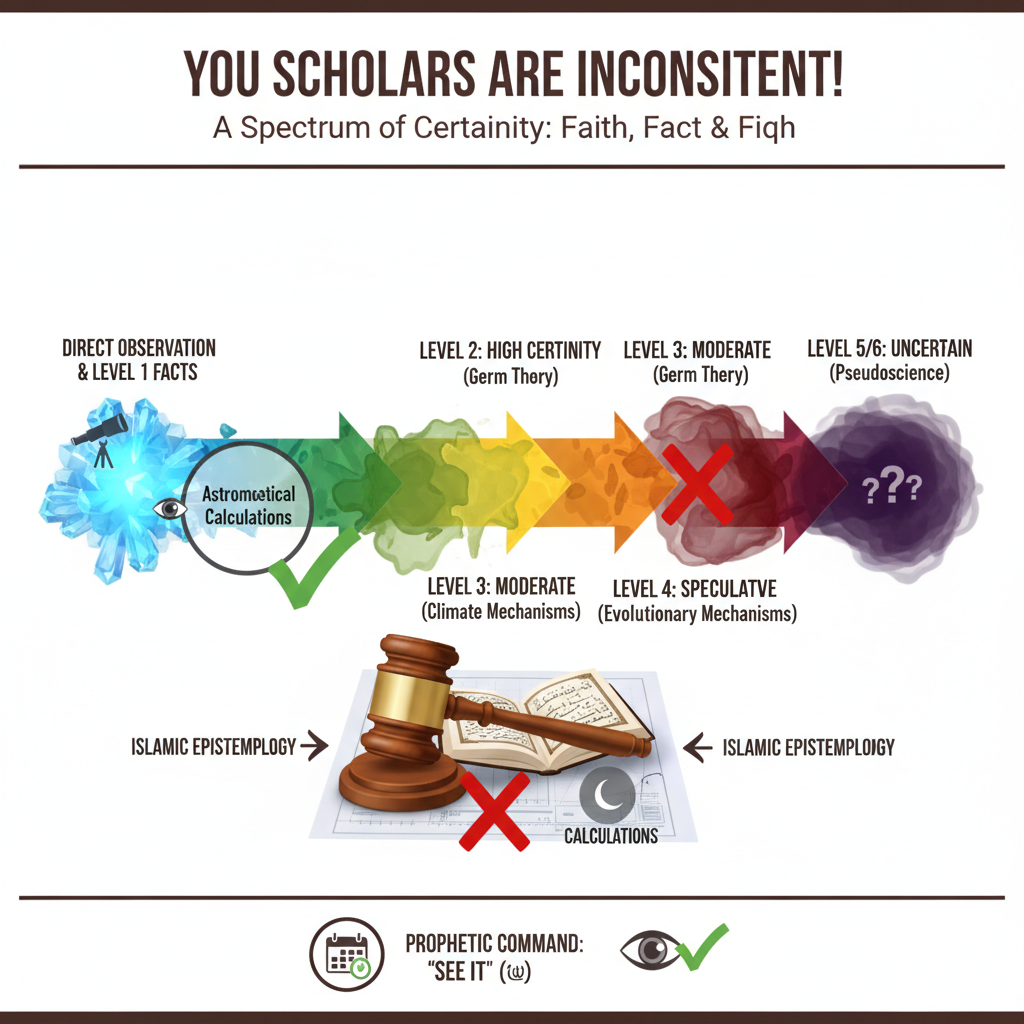
Moonsighting: Science Here and Not There?!
This tackles a common objection that scholars are selectively using science.
👉Moonsighting: Science Here and Not There
Are You Saying All Scholars Need To Be Astronomers?
This tackles a common objection that all scholars need to be astronomers if we set the standard of negating testimony using astronomical calculations.
👉Are You Saying All Scholars Need To Be Astronomers?
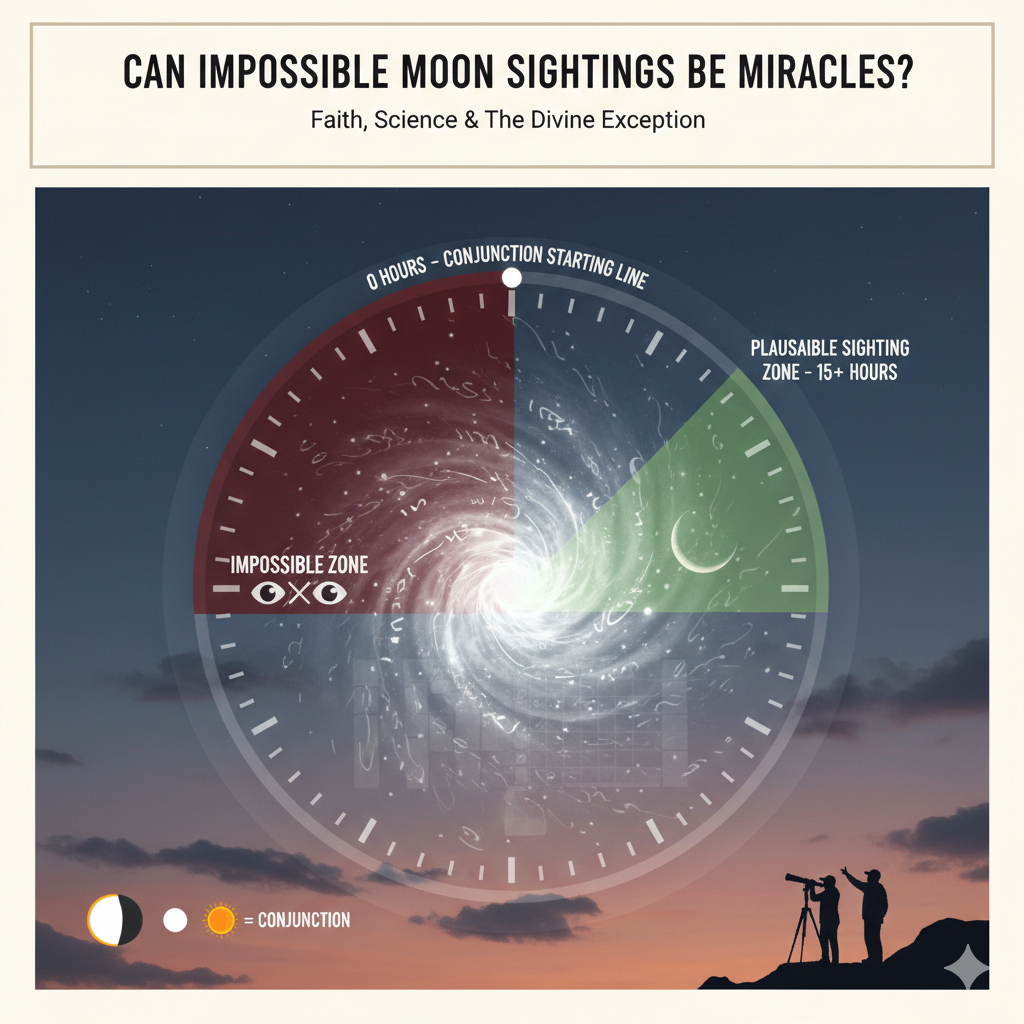
Impossible Moon Sightings Or Miracles?
This tackles an objection that all these impossible sightings are miracles.
👉Impossible Moon Sightings Or Miracles?
Have Feedback or Want to Get in Touch?
Feel free to reach out on Twitter or Facebook.
If you’re in Atlanta, you can also join our WhatsApp group to:
- Get authentic updates for Eid and other local moon sightings
- Receive continuous educational content throughout the year
Moon Fighting Madness: The Ultimate Crash Course For The Confused
Frustrated by conflicting Eid announcements? Invest just 5 minutes, and you’ll walk away with clarity that cuts through the noise. This isn’t just another article – this is your key to understanding it all.
Introduction
If you’re reading this, you’re likely a Muslim in the USA. You might be a board member or Imam of a Masjid or leader of a household feeling the weight of making the correct decision.
This article offers a straightforward explanation of the moon sighting controversy from March 29, 2025 – perfect for anyone seeking to understand this issue without needing technical knowledge or expertise. Whether you’re completely new to this topic or just looking to clear up common misconceptions, this guide aims to provide all the information you need in one place.
Let’s explore the million dollar question: Could observers in Sokoto (Nigeria), Tumair (Saudi Arabia), and Kabul (Afghanistan) have seen the new moon on March 29, 2025, as has been claimed? Scientific evidence indicates this would be physically impossible, raising important questions about these reported sightings.
The Moon Visibility Basics
For a new moon to become visible, several factors need to align:
- The moon needs to be old enough since birth (conjunction)
- It needs to be far enough away from the sun’s glare
- The crescent needs to be wide enough to reflect sufficient light
- It needs to remain above the horizon after sunset
- The sky conditions need to be favorable
Think of it as trying to spot a silver needle – you need the right light, the right angle, and the right timing, or you’ll miss it completely!
The Claims vs. Scientific Reality
Reported Sightings
People claimed to see the crescent moon on March 29, 2025, in:
– Sokoto, Nigeria (moon age: 6h 53m)
– Tameer, Saudi Arabia (moon age: 4h 14m)
– Kabul, Afghanistan (moon age: 2h 47m)
What Science Says
According to carefully documented records:
- The youngest moon ever reliably seen with the naked eye was about 15 hours 32 minutes old
- The youngest moon observed using binoculars was about 11 hours 40 minutes old
This means the reported sightings were of crescents 2-5 times younger than the best-ever documented observations (Schaefer et al., 1993). That’s quite the astronomical achievement!
Understanding Practical Impossibility vs. Mere Improbability
Many people might think, “Well, it’s just very unlikely, but still possible with good eyesight or the right equipment.” This misunderstands the distinction between:
Mere Improbability: Something that’s rare but could happen with luck or skill. Example: Drawing a royal flush in poker. Unlikely, but happens regularly somewhere in the world.
Practical Impossibility: Something that violates physical limitations to such a degree that it cannot realistically occur. Example: Jumping 50 feet high unaided by equipment.
The moon sightings on March 29 fall firmly in the “practically impossible” category because:
- The crescent was too thin to reflect enough light to be visible (like trying to see a strand of hair from a mile away)
- The moon was too close to the sun’s glare (like trying to spot a candle flame next to a spotlight)
- The required visual acuity would exceed the physical limitations of the human eye by several times
No amount of perfect conditions, excellent eyesight, or even standard telescopes can overcome these physical limitations. This isn’t about probability – it’s about the physical limits of light reflection, atmospheric diffraction, and human visual perception.
Even the world’s most advanced telescopes would struggle to detect a crescent this young – and claims of seeing it with the naked eye or binoculars go beyond what’s physically possible, not just what’s improbable.
Don’t Use Astronomical Calculations To Negate Testimony? Wrong.
Yes, you do.
Even those who claim to reject astronomical calculations end up relying on them — just selectively.
Imagine someone came forward on the 27th night of Ramadan claiming to have sighted the new crescent. Would these same individuals accept it? Of course not. Why? Because everyone knows the moon can’t be seen that early. And how do we know that? From the very same astronomical data they claim to disregard.
The same science that tells you the moon is definitely not visible on the 27th is also telling you it was impossible to sight the crescent on the 29th of March, 2025.
Just because one is easier to understand doesn’t make it more true than the other.
Algebra and Calculus are just as definitive as 2 + 2 = 4 even if they take longer to understand.
You can’t pick and choose. Either the data is reliable, or it isn’t.
Putting This in Perspective
The Sports Record Analogy
Imagine someone claiming to run 100 meters in 3 seconds when Usain Bolt’s world record stands at 9.58 seconds. We’d be asking if they teleported or had rocket boosters in their shoes! The moon sighting claims represent an even bigger leap – it’s like claiming to swim across the English Channel in 30 minutes when the record is over 7 hours, without growing fins or befriending a dolphin.
The Visual Challenge
Seeing a 2-7 hour old crescent is like:
– Trying to spot a single eyelash floating in an Olympic swimming pool… at midnight… from the bleachers
– Reading the fine print on a candy wrapper from a quarter-mile away
– Finding a specific snowflake in an avalanche
– Hearing a whisper from across a crowded football stadium
It’s not just difficult – it’s in the realm of “good luck with that!”
What Might Explain These Reports?
Scientific research offers several insights into why sincere observers might report seeing an impossible lunar crescent:
- Misidentification of celestial objects: Other bright objects like Venus can look similar to a moon crescent from certain angles.
Atmospheric phenomena: Sky conditions can create misleading light patterns that resemble a crescent shape.
Expectation bias: People’s strong expectations can make them perceive what they want to see, especially in culturally significant moments.
Social and institutional pressure: Group expectations can unconsciously influence individual observations and testimonies.
Inaccurate testimony: While most reports are well-intentioned, some may be influenced by unspoken institutional or political motivations.
These explanations align with documented patterns of perception and testimony, offering plausible alternatives to physically impossible astronomical observations.
The why would they lie argument?
Facts First, Motives Second.
When someone asks, “Why would anyone claim to see the moon that wasn’t there?” they’re skipping a crucial first step.
This is like a detective who, when shown blood evidence, fingerprints, and security footage of a suspect committing a crime, says: “But this suspect seems like such a nice person – why would they do this? Let’s ignore all that evidence.”
A more logical approach would be:
1. Examine the physical evidence to determine what actually happened
2. Only after establishing the facts, consider questions of motive or intention
The physical laws of astronomy don’t change based on human character or intentions – they’re consistent whether we understand someone’s motivations or not.
Why Use Science to Negate Moon Sightings But Not to Establish Them?
This approach is grounded in fundamental principles of Islamic legal interpretation:
Preserving the Prophet’s Clear Instructions
The Prophet Muhammad ﷺ instructed: “Fast when you see it (the crescent) and break your fast when you see it…” (Bukhari and Muslim). The word “see” (ru’yah) clearly refers to visual observation with the human eye.
The Importance of Apparent Meanings
Taking words at their apparent meaning (dhaahir) is essential in Islamic textual understanding. If we decide “seeing the moon” actually can mean “calculating the moon’s position,” we open a dangerous door that undermines not only the entire foundation of Islamic practice but also the basic function of human language itself.
Scholars who insist on the literal meaning of “seeing” in this context aren’t merely being rigid about one particular issue – they are defending a fundamental interpretive principle that protects the entire religion. This principle of adhering to the apparent meaning of texts (haqiqah) unless compelling evidence indicates otherwise is what preserves the integrity of Islamic law and practice across all domains.
Consider how arbitrary reinterpretation undermines clear communication:
- If a legal document says “sign on the dotted line,” would you consider typing your name elsewhere or drawing a star symbol to fulfill this requirement? Of course not! The word “sign” clearly means writing your signature in the specific indicated location.
When a warranty states “proof of purchase must be presented for all returns,” would any store accept that you simply described your purchase experience verbally without showing a receipt? The meaning of “presented” obviously requires physically showing the document.
If a medical consent form states “patient must initial each page,” would any doctor accept mathematical calculations about your name instead of your actual handwritten initials? This would completely change what’s being requested.
When a tax form instructs you to “attach W-2 form here,” would the IRS consider it compliance if you merely calculated your income without including the actual document? The instruction clearly calls for the physical document.
These examples show how replacing the apparent meaning with an alternative interpretation fundamentally changes the nature of what’s being asked. Similarly, when the Prophet ﷺ said to “see the crescent,” reinterpreting this to mean “calculate its position” changes a direct sensory instruction into a completely different mental activity.
Consider these examples that show how changing the meaning of a single word transforms religious practice:
- When Allah commands us to “obey the Messenger,” all Muslims understand the word “obey” to mean actually following his instructions as given. If we allowed “obey” to also be interpreted as “consider his advice while making your own judgment,” the entire concept of religious authority would be undermined.
When the Quran instructs Muslims to “lower their gaze,” the word “lower” is understood as physically directing one’s eyes downward away from inappropriate sights. If we reinterpreted “lower” to mean “mentally ignore while still looking,” the physical action explicitly commanded would be replaced with a mere internal attitude.
In the same way, when the Prophet ﷺ explicitly instructed Muslims in the hadith: “Fast when you see it (the crescent) and break your fast when you see it” (صوموا لرؤيته وأفطروا لرؤيته) as reported in Bukhari and Muslim, the word “see” (رؤية/ru’yah) unambiguously refers to visual observation with the human eye. If we allowed “see” in this hadith to also be interpreted as “determine through calculation,” we would be changing the fundamental nature of the command from a physical action (looking with the eyes) to a mental exercise (calculating positions). This would not only contradict the Prophet’s ﷺ clear intent but would open the door to reinterpreting other explicit commands throughout Islamic texts.
Each of these examples shows how changing just one key word’s meaning can fundamentally alter religious practice while seeming to maintain some connection to the original command.
When scholars stand firm on this point, they’re not just defending moon sighting – they’re guarding the methodological foundation upon which our understanding of all Islamic texts is built. If this principle is compromised for convenience in one area, the same logic can be applied elsewhere, gradually eroding the entire framework of textual interpretation.
This isn’t about being rigid – it’s about being principled and consistent. When we accept arbitrary departures from apparent meaning in one area, we undermine the entire textual foundation of the religion and the very possibility of clear communication.
Islamic Tradition Already Balances Testimony and Facts
Islamic scholarship has consistently evaluated testimony against known physical facts:
1. Implausible Witnessing of Transactions
If a witness testified in Islamic court that they observed the details of a business transaction that took place inside a closed room while they were standing outside the building, the testimony would be rejected. Islamic judges recognize that witnesses cannot see through solid walls, regardless of their character or trustworthiness.
2. Calendar Impossibilities
If witnesses came to an Islamic court claiming they had seen the new crescent moon on the 27th day of the lunar month, their testimony would be dismissed because the moon physically cannot complete its cycle in less than 29 days – a fact acknowledged in Islamic astronomy and legal texts.
3. The Location Question
If a witness testified in court that they saw the same person in Mecca and Medina at the exact same time (when it takes hours to travel between them), the testimony would be rejected because a person cannot physically be in two places at once.
4. Vision Limitations
If a witness in court claimed they clearly saw someone’s face at night from two miles away without any lighting or visual aids, the judge would question this testimony because it exceeds the natural capabilities of human eyesight.
5. Weather Contradictions
If a witness testified they saw someone slip and fall due to heavy rain on a certain day, but weather records, mosque attendance records, and numerous other witnesses confirmed it was actually a clear, dry day, the testimony would be considered questionable despite the witness’s character.
The “It’s On Their Heads” Misconception
Some might say, “So what if witnesses give impossible testimony? Let’s accept it and the sin will be on their heads if they’re lying.”
This misunderstands a fundamental principle in Islamic jurisprudence. Islamic courts cannot knowingly base rulings on physically impossible claims – that would undermine the entire judicial system. Judges have a religious and legal obligation to evaluate testimony against known facts.
In none of the examples above would a qadi (judge) say, “Well, I know you can’t see through walls, or be in two places at once, or see in complete darkness, but I’ll accept your testimony anyway and if you’re lying, that’s between you and Allah.” Such an approach would make Islamic courts meaningless and contradict the Quranic principle of justice based on truth and evidence.
The same principle applies to moon sighting. When testimony contradicts established physical realities, scholars have a responsibility to scrutinize it – not to accuse witnesses of lying, but to protect the integrity of the system that determines religious timings for the entire community.
These straightforward examples show that Islamic courts have always weighed testimony against basic physical facts. The tradition recognizes that even honest people can be mistaken, and testimony that contradicts established physical reality requires careful scrutiny.
What the Experts Say
Multiple independent astronomical organizations have published visibility models and criteria that classify these claimed sightings as impossible:
- His Majesty’s Nautical Almanac Office (UK) – a government scientific body with no religious affiliation – produces global visibility maps showing that the crescent would be below visibility thresholds in these regions on March 29, even with telescopes (Middle East Eye, 2025; HM Nautical Almanac Office, 2025).
The International Astronomy Centre (UAE) – a secular scientific institution – has developed visibility models indicating moon sighting would be “impossible in the eastern parts of the world and unfeasible across the rest of the Arab and Islamic world, even with advanced observation tools” (The Daily Tribune, 2025; International Astronomy Centre, 2025).
NASA – the U.S. space agency – provides astronomical data describing the March 29 new moon as “essentially invisible from the surface” except during solar eclipses (NASA Science, 2025).
The Royal Observatory Greenwich – a centuries-old scientific institution unaffiliated with any religious organization – utilizes astronomical criteria that would classify these sightings as below the threshold of visibility (Middle East Eye, 2025).
The U.S. Naval Observatory – a scientific organization under the Department of the Navy – publishes crescent visibility standards indicating conditions in these locations were far below minimum visibility thresholds (U.S. Naval Observatory, 2025).
These assessments are based on universally applied astronomical principles and visibility models developed through decades of scientific observation and research.
The Subcontinent Scholars Argument: Are They Racist?
Some might wonder, “Are Subcontinent scholars just rejecting Saudi sightings because they always disagree with Saudi or African sightings because they don’t like Africans?” Let’s break this down honestly:
First, these scholars aren’t selectively rejecting Saudi claims. They’ve consistently applied the same scientific and Islamic principles to moon sightings from multiple countries:
- They rejected Saudi Arabia’s claims
- They rejected Nigeria’s claims
- They rejected Afghanistan’s claims
All were rejected for the same fundamental reason: the physical impossibility of seeing the moon at those times.
Also, what motive exists to needlessly reject Saudi sightings. These are sincere attempts to determine the correct Islamic date. The scholars aren’t attacking individuals – they’re protecting the integrity of religious observance by insisting on verifiable, physical evidence.
The real issue isn’t about countries or personalities – it’s about a shared framework of moon sighting that, if not carefully applied, leads to repeated inaccuracies.
The Framework Problem: A Systemic Issue
There’s a deeper concern here. For countries that consistently report impossible moon sightings, the problem isn’t individual dishonesty – it’s a flawed systematic approach. Their current framework lacks a critical step: rigorous verification against scientific observable fact.
Any country that adopts this same approach will inevitably encounter the same issues. It’s not about pointing fingers – it’s about improving our collective method of determining important religious dates.
Who’s Celebrating Eid When?
It’s important to know you’re not alone. Other Arab countries like Jordan, Syria, Egypt, and Oman are observing Eid on Monday, March 31, 2025 despite being the same same area as Saudi Arabia. In the United States, major cities like Chicago and New York are also celebrating Eid on Monday. Communities all around the US are celebrating Eid on Monday. This widespread observance shows that the decision to celebrate Eid on Monday is based on careful consideration and scientific evidence, not isolation.
The Scholar’s Responsibility: Seeking Truth
Scholars have a sacred duty: to seek and uphold the truth, even when it’s uncomfortable. This isn’t about winning arguments or defending reputations. It’s about carefully examining evidence, challenging claims with respect, and guiding the community toward what is most accurate and just. When presented with claims that contradict physical reality, true scholarship demands rigorous investigation and honest reporting.
Are The People Who Celebrated Eid Sunday Excused?
Being excused is another discussion. But let’s be clear: accuracy matters in religious observance. Good intentions do not change fundamental facts. If someone celebrated Eid on Sunday, regardless of their sincerity, they undoubtedly celebrated on the 30th of Ramadan – and the weight of that decision falls on those who made it, especially those in leadership positions.
This isn’t about casting blame, but about maintaining the precision of our religious practice. Sincerity is commendable, but it must be coupled with a genuine commitment to understanding and following the most correct Islamic principles and unifying the community on the correct position, even if it requires a bit of studying.
Conclusion
This isn’t about science versus religion playing tug-of-war. It’s about maintaining the integrity of both. Islamic tradition has always recognized that testimony should make sense in the real world we all share.
When claimed observations fall so far outside established limits—by factors of 2-5 times beyond documented records—they deserve a friendly “Are you sure about that?” conversation.
By acknowledging the physical challenges of these claimed sightings, we’re actually protecting the principle of taking religious texts at their apparent meaning, ensuring that “seeing” remains connected to what human eyes can actually see.
Anyways, whether you’re moonsighting with binoculars, WhatsApp scholars, or just your gut feeling—remember, it’s not madness. It’s tradition, love, and a little bit of chaos stitched together under one sky.