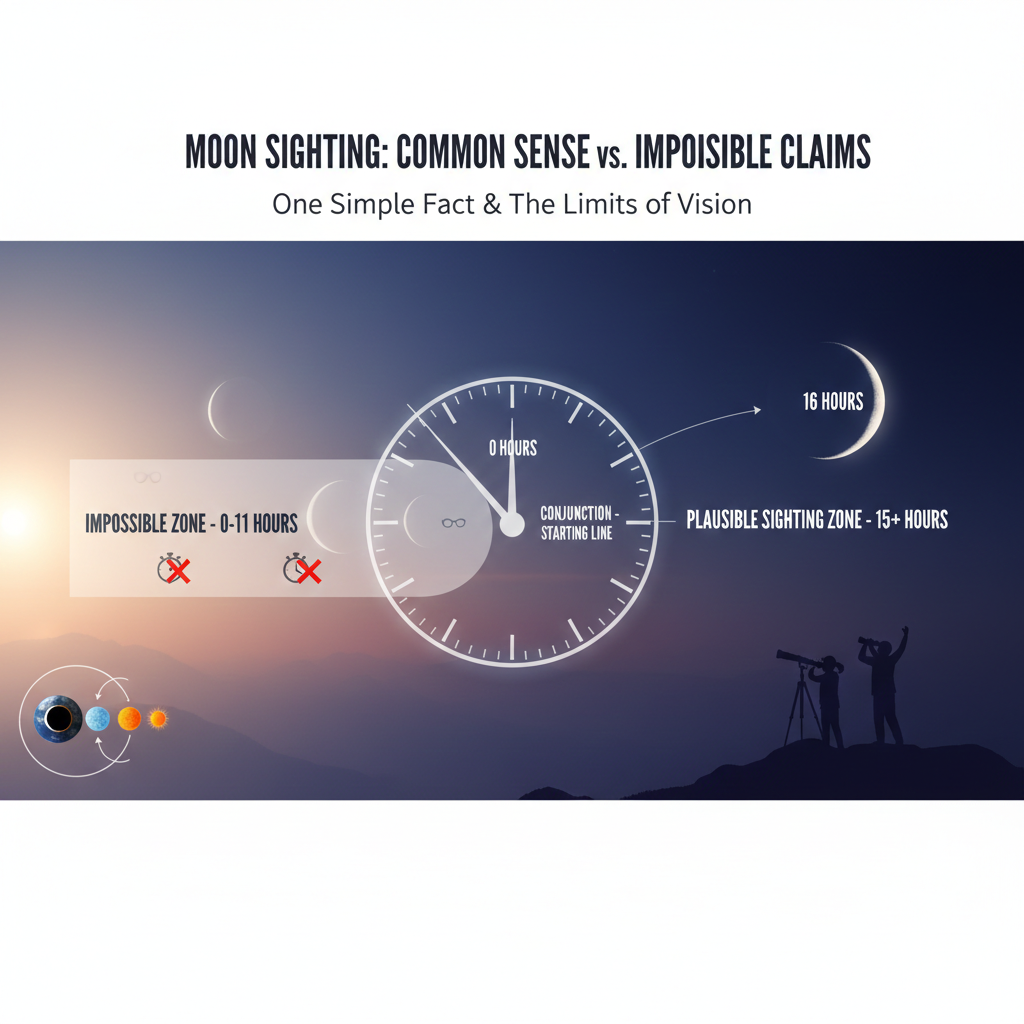
This article explores the logical fallacy of declaring ‘the moon is too big’ as proof of anything.
The Flawed Logic:
– Big moons mean earlier Eid was correct
– This moon? Definitely big
– Our Eid was Earlier. Therefore, our Eid was correct. Boom! 🌙✨
Simple Examples to Understand the Problem
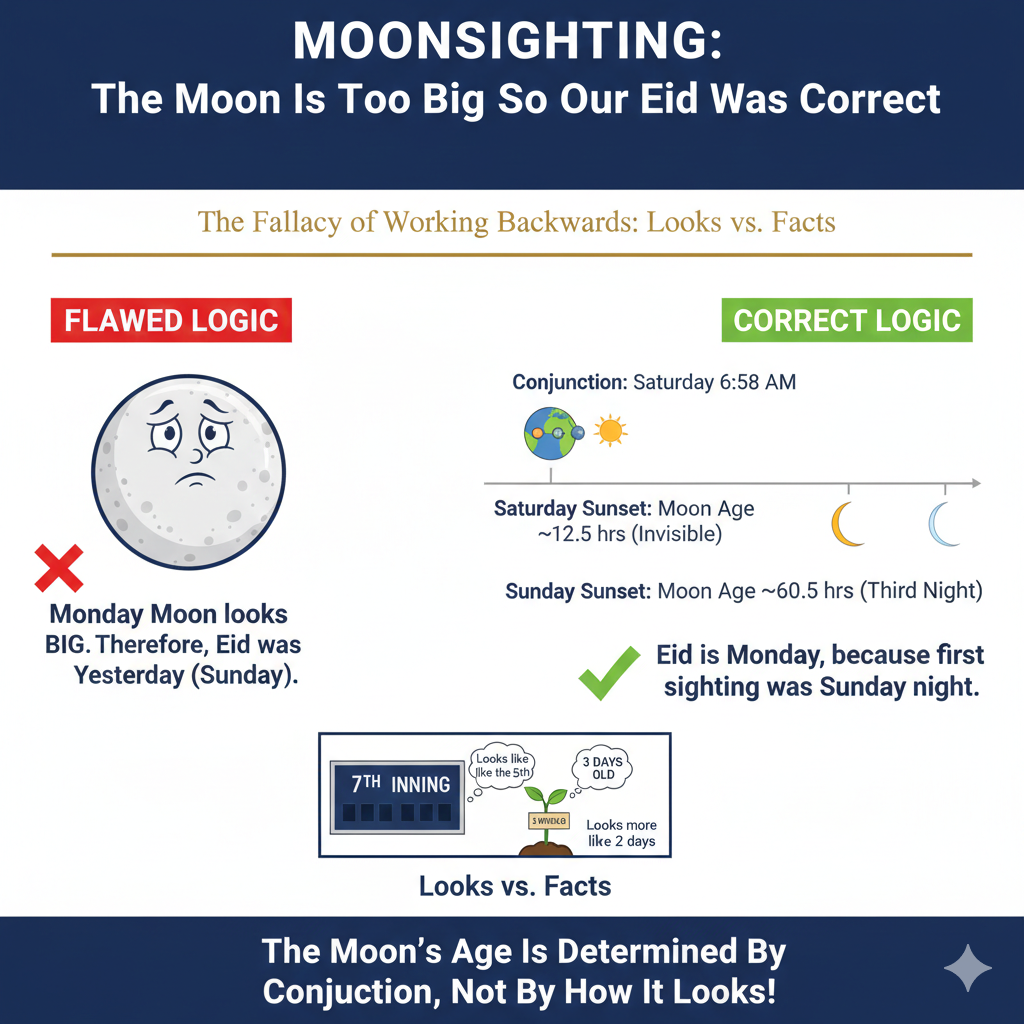
Claiming “Monday night’s moon looks too big to be a second night’s moon!” is making a fundamental logical error. Here’s why:
Example 1: The Baseball Game
This is like arriving at a baseball game and seeing the scoreboard shows “7th inning,” but declaring “This must be the 5th inning!” just because you think the game doesn’t look like it’s in the 7th inning. The inning number isn’t determined by how the game looks to you, but by the actual sequence of events from the start.
Example 2: The Growing Plant
Imagine looking at a sprouting plant that’s 3 inches tall and saying “This can’t be 5 days old – it looks more like 3 days old to me!” But the plant’s age isn’t determined by how tall you think it should be – it’s determined by when it was actually planted.
The Fundamental Error: Working Backwards
The basic problem is working backwards instead of forwards:
- The correct approach: Start with the known, fixed point (conjunction) and move forward in time to determine what the moon should look like on each night.
The incorrect approach: Look at Monday night’s moon, guess how old it “seems,” and work backwards to determine which day should have been Eid.
Islamic Calendar Basics: What Determines the Start of a Month
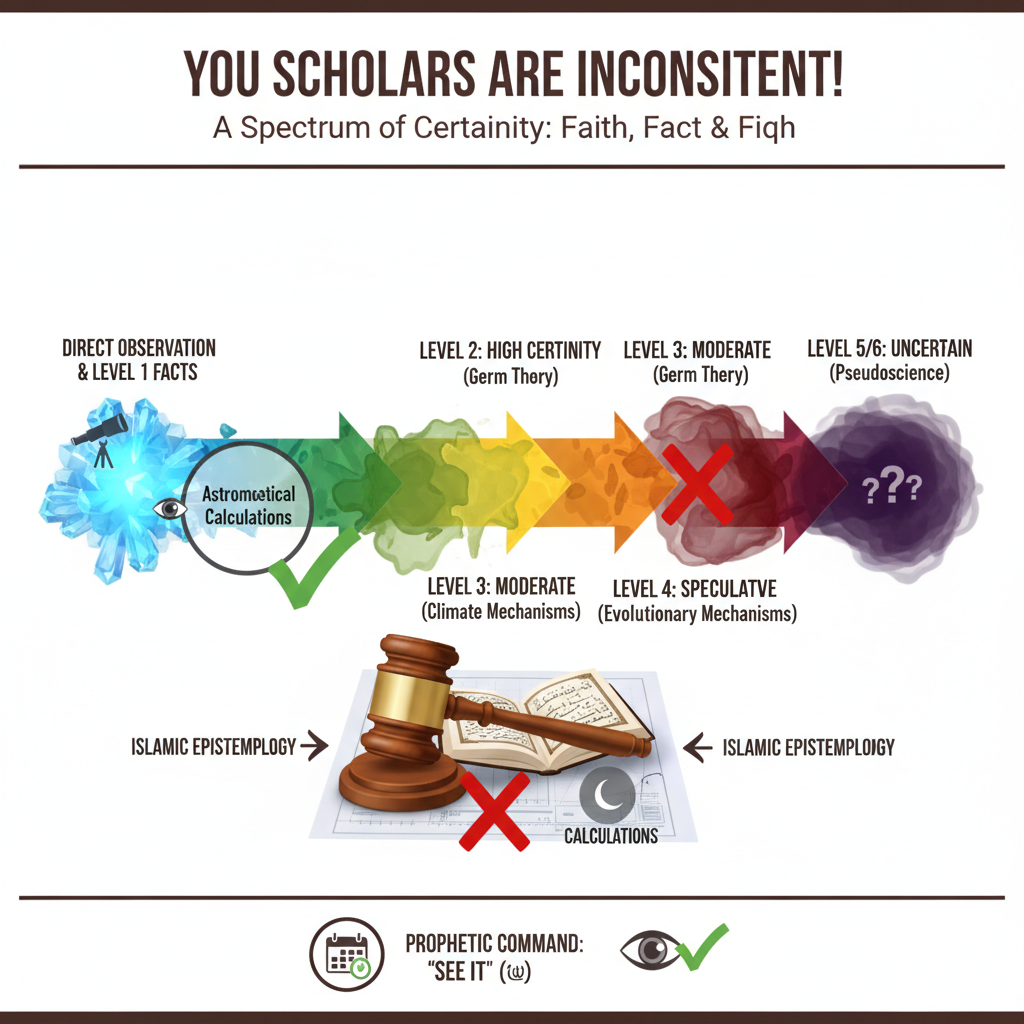
The Islamic month begins with the sighting of the new crescent moon (hilal) after it’s invisible period, as instructed by the Prophet Muhammad (peace be upon him) in authentic hadith. This is fundamental to our calendar system.
While conjunction (astronomical new moon) doesn’t directly start the Islamic month, it’s the objective starting point from which we calculate when the crescent will become visible. We always:
1. Identify when conjunction occurs
2. Calculate how old the moon will be by sunset
3. Determine when the crescent should become visible to the human eye
We follow the Prophet’s guidance to start the month with the sighting of the crescent, not with conjunction itself.
Age of the moon: Determined by conjunction
Age of the month: Determined by the first visible crescent
The Facts We Know For Certain
Conjunction is the exact moment when the moon passes between Earth and sun – the astronomical “new moon.” For March 2025:
- Conjunction: Saturday, March 29 at 6:58 AM EDT (Eastern Time, Atlanta)
- This timing is precisely calculated (like eclipse predictions)
- This is the true “birth” of the lunar cycle
After conjunction, the moon’s illumination grows predictably:
| Moon Age | Illumination |
|---|---|
| 0 hours | 0% |
| 24 hours | ~1-1.2% |
| 48 hours | ~3-4% |
| 72 hours | ~6-7% |
For Atlanta/Eastern Time in March 2025, this means:
– Saturday sunset (~7:30 PM): Moon age ~12.5 hours (0.2-0.3% illuminated)
– Sunday sunset: Moon age ~36.5 hours (2-3% illuminated)
– Monday sunset: Moon age ~60.5 hours (4-5.5% illuminated)
The Wide Variation in First-Day Crescents
When Can a Crescent Moon First Be Seen?
Best-Case Scenario
Moon age: approximately 15 to 20 hours
Moon illumination: approximately 0.5% to 1.0%
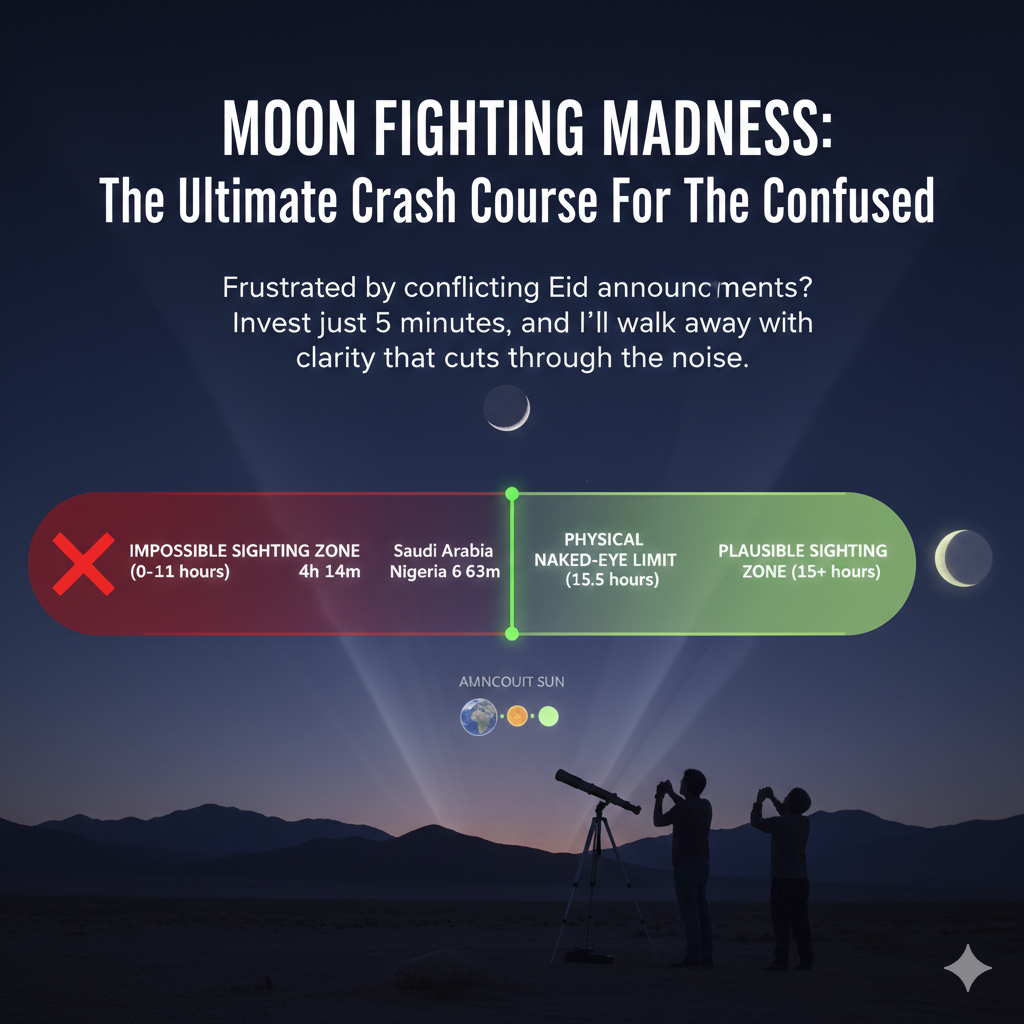
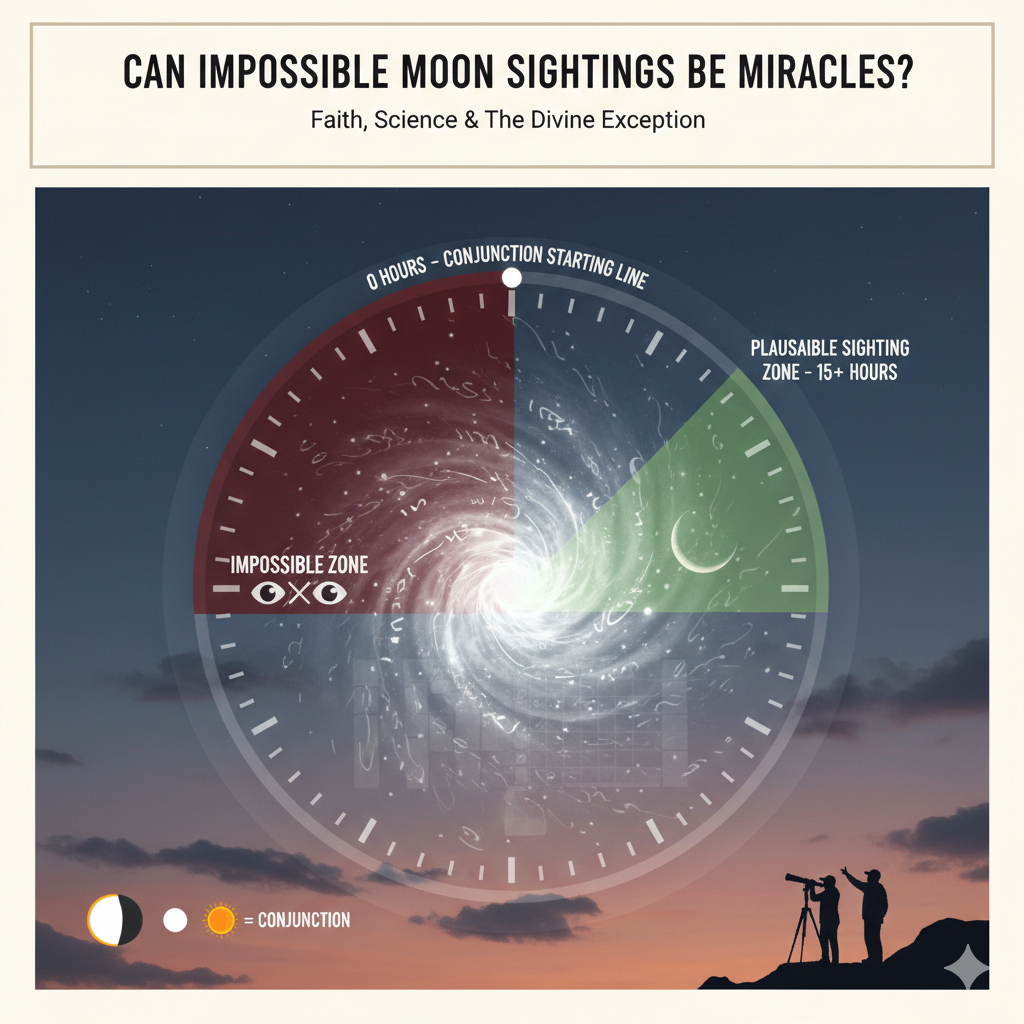
The youngest crescent ever seen with the naked eye was 15 hours and 32 minutes after conjunction, observed by Mohamed Odeh in Jordan in 1990.
Worst-Case Scenario
Moon age: approximately 72 hours (3 days)
Moon illumination: approximately 6% to 7%
The critical point: The crescent that begins an Islamic month can vary dramatically in appearance. A Muharram crescent might be just 20 hours old with 1% illumination, while a Shaban crescent might be 72 hours old with 7% illumination. Both are valid first-day crescents despite looking very different.
This means pictures of the moon prove nothing about whether it’s the “right” thickness for a particular day. The Monday night moon was exactly what astronomers would expect for a moon that’s 60.5 hours old from conjunction.
Applying This to March 2025: The Simple Test
A simple question exposes the flaw in their reasoning: “Did anyone actually see the crescent moon on Saturday night?”
The answer is no – because it was physically impossible:
– Saturday night’s moon was only 12.5 hours old (0.2-0.3% illuminated)
– This is below even the world record for youngest moon ever seen
– No human eye could have seen it
Therefore: If Sunday was truly the first day of Eid, people would need to have seen the moon Saturday night – but that was impossible.
The Monday night moon (60.5 hours old, 4-5.5% illuminated) was exactly what astronomers would expect for a moon in its third day after conjunction.
Why “It Looks Too Big” Is Not Valid Evidence
- Subjective assessment isn’t reliable: Can the average person accurately judge a moon’s age by looking at it?
- No measurements: Only feelings and impressions, not data
- No control group: What are they comparing it to?
- Ignores objective evidence: The precise time of conjunction
Why The Misconception Spreads
This erroneous “proof” gains traction because:
1. It seems intuitive to non-experts
2. It requires no understanding of astronomy
3. It’s easy to share on social media
4. It confirms what people want to believe
But popularity doesn’t make something true. The moon’s age is determined by when conjunction actually occurred, not by how old someone thinks it looks.
The Bottom Line
- We know conjunction happened Saturday morning
- The crescent couldn’t possibly be seen Saturday night (12.5 hours old)
- The first possible sighting was Sunday night (36.5 hours old)
- Therefore Monday was the correct first day of the month (Eid)
- The Monday night moon looked exactly as it should for a 60.5-hour-old moon
Looking at the moon on Monday and saying “this moon is too big to be a second-day moon” is like looking at a 5-year-old child and saying “this child can’t be 5 because they look too tall.”
The child’s age depends on their birthday, not how tall they look. Similarly, the moon’s age depends on when conjunction happened, not how big it looks to us.